
At first glance, Mumbai appears to have no shortage of water. The city is surrounded by the Arabian Sea, experiences heavy monsoon rainfall and is home to several lakes. Yet, every drop of drinking water supplied to millions of residents comes from freshwater reservoirs located well beyond the city limits. This unique system has evolved over decades to ensure a reliable supply of safe drinking water throughout the year. Understanding why Mumbai depends on distant reservoirs also highlights the importance of protecting these invaluable water sources for future generations.
📑 In This Article
- Why Mumbai Depends on Distant Reservoirs
- The Limits of Mumbai’s Natural Freshwater Sources
- Why the Western Ghats Are Ideal for Water Storage
- Why Seawater Is Not Mumbai’s Primary Drinking Water Source
- Can Rainwater Harvesting Solve Mumbai’s Water Needs?
- Why Protecting Reservoir Catchments Is Essential
- Building a Reliable Water Supply Network
- Looking Ahead: Securing Mumbai’s Water Future
- Frequently Asked Questions
Why Mumbai Depends on Distant Reservoirs
Mumbai’s dependence on distant reservoirs is the result of geography, population growth and the need for a dependable source of clean drinking water. While the city occupies a narrow peninsula along the Arabian Sea, it has very little land available for constructing large freshwater reservoirs. As Mumbai expanded from a small port town into one of the world’s largest metropolitan cities, local water sources could no longer meet the increasing demand.
To overcome this challenge, engineers identified river valleys in the neighbouring districts where heavy monsoon rainfall, hilly terrain and large catchment areas made it possible to store enormous quantities of freshwater. Today, reservoirs located between approximately 25 and 175 kilometres from Mumbai collectively supply nearly all of the city’s drinking water.
The Limits of Mumbai’s Natural Freshwater Sources
Before the development of modern reservoirs, Mumbai relied on wells, ponds and small lakes for its daily water needs. These sources were adequate when the population was relatively small, but they soon became insufficient as industries, trade and residential areas expanded across the city.
Although Vihar and Tulsi Lakes continue to contribute to Mumbai’s water supply, together they account for only a small share of the city’s overall requirement. Their limited storage capacity means they cannot support the needs of millions of residents throughout the year, making larger reservoirs outside Mumbai essential.
Why the Western Ghats Are Ideal for Water Storage
The Western Ghats receive some of the highest rainfall in Maharashtra during the southwest monsoon. Rivers originating in these hills flow through deep valleys that provide ideal locations for constructing dams and creating large reservoirs.
Reservoirs such as Bhatsa, Upper Vaitarna, Middle Vaitarna, Modak Sagar and Tansa benefit from vast forested catchments that collect and store rainwater naturally. This allows sufficient water to be stored during the monsoon and supplied to Mumbai during the remaining months of the year.
Why Seawater Is Not Mumbai’s Primary Drinking Water Source
Being surrounded by the Arabian Sea does not automatically solve Mumbai’s drinking water needs. Seawater contains high concentrations of dissolved salts and minerals, making it unsuitable for direct human consumption.
Although desalination technology can convert seawater into drinking water, the process requires substantial energy and involves high construction and operating costs. For this reason, freshwater collected during the monsoon remains Mumbai’s most practical and economical source of drinking water, while desalination is being considered only as a supplementary option for the future.
Can Rainwater Harvesting Solve Mumbai’s Water Needs?
Mumbai receives abundant rainfall every year, but most of it falls within just four months. Without large storage facilities, rainwater quickly flows into stormwater drains, rivers and eventually the Arabian Sea.
Rainwater harvesting plays an important role in reducing dependence on municipal supplies, especially for housing societies, commercial buildings and institutions. However, the amount that can be collected within the city is far smaller than the daily requirement of the entire metropolitan population. It is therefore a valuable supplementary measure rather than a complete solution.
Why Protecting Reservoir Catchments Is Essential
The quality of Mumbai’s drinking water depends not only on treatment plants but also on the health of the reservoir catchments. Forests surrounding these reservoirs help retain rainfall, reduce soil erosion and minimise the amount of sediment entering the water bodies.
To preserve water quality, many catchment areas are protected from excessive development and activities that could pollute the reservoirs. Conserving these natural landscapes is one of the most effective ways of safeguarding Mumbai’s long-term water security.
Building a Reliable Water Supply Network
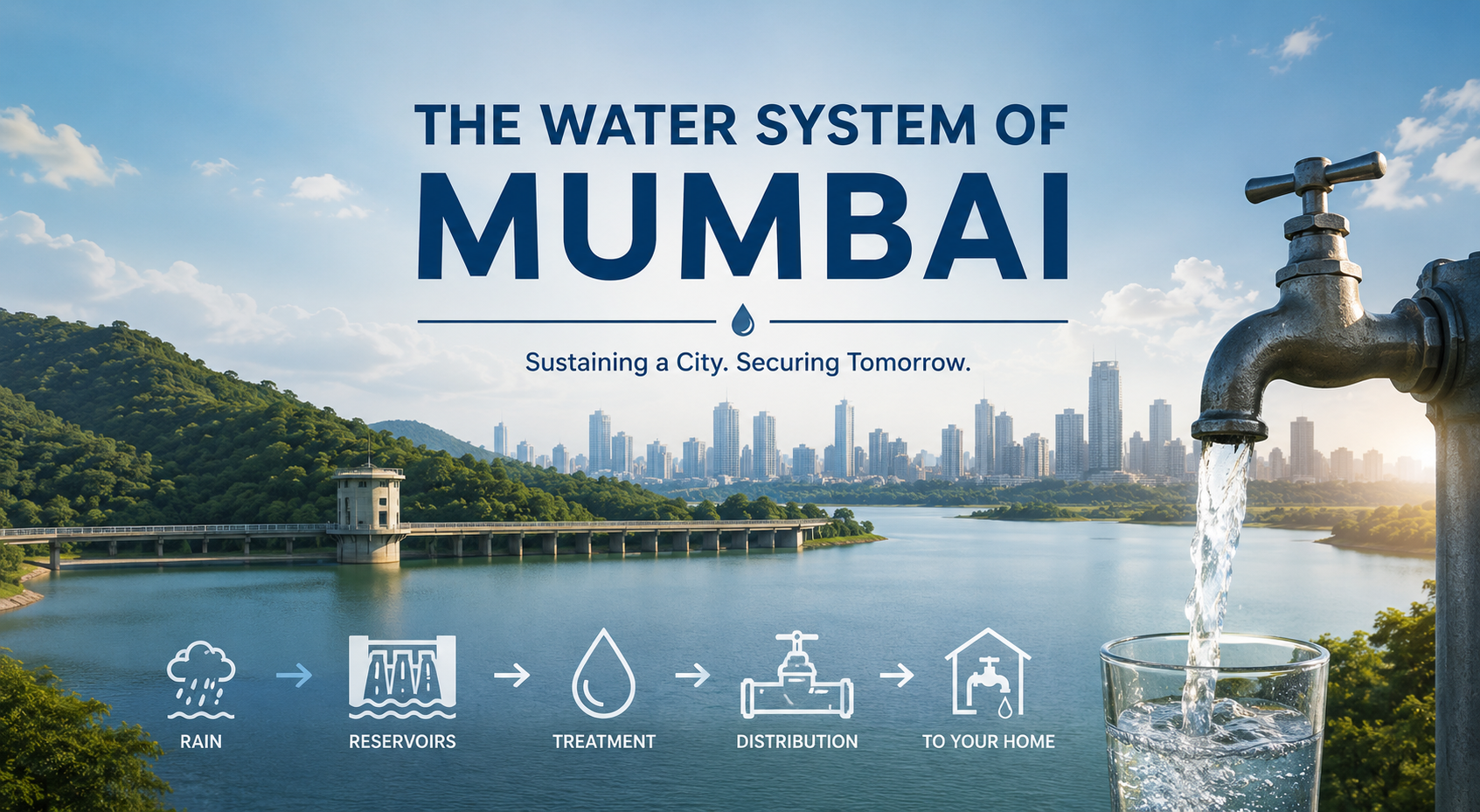
Rather than depending on a single source, Mumbai draws water from seven reservoirs located in different river basins. This diversified system provides greater reliability, particularly during years when rainfall varies from one catchment to another.
Water from these reservoirs is transported through an extensive network of tunnels, pipelines, pumping stations and treatment plants before being distributed across the city. Continuous monitoring and infrastructure upgrades help ensure that safe drinking water reaches consumers throughout the year.
Looking Ahead: Securing Mumbai’s Water Future
Mumbai’s population continues to grow, while changing rainfall patterns and increasing demand place additional pressure on existing water resources. To strengthen future supplies, authorities are pursuing new reservoir projects, exploring desalination, improving pipeline efficiency and promoting water conservation measures.
Ensuring a sustainable water supply will require not only new infrastructure but also responsible use of water, protection of reservoir catchments and continued investment in modern water management practices.
Frequently Asked Questions
Why doesn’t Mumbai use seawater for drinking?
Seawater contains high levels of salt and requires desalination before it becomes suitable for drinking. The process is expensive and energy-intensive, making freshwater reservoirs a more practical source.
Which areas supply most of Mumbai’s drinking water?
Most of Mumbai’s drinking water comes from reservoirs located in the Thane and Nashik regions, where heavy monsoon rainfall fills large storage reservoirs.
Can Mumbai become self-sufficient using rainwater harvesting?
Rainwater harvesting helps reduce dependence on municipal water but cannot replace the city’s large reservoir network due to Mumbai’s enormous daily water demand.
Why are reservoir catchments protected?
Protected catchments help maintain good water quality by reducing pollution, preserving forests and limiting soil erosion before water reaches the reservoirs.
Explore More About Mumbai's Water Supply System
Continue learning about how Mumbai stores, treats and supplies drinking water through our detailed guides.
Sources
- Brihanmumbai Municipal Corporation (BMC) – Water Supply Department.
- India Meteorological Department (IMD).
- BMC Environment Status Reports.
- Government of Maharashtra – Water Resources Department.
- Central Water Commission.
Sources
- Brihanmumbai Municipal Corporation (BMC) – Water Supply Department.
- BMC Environment Status Reports.
- Government of Maharashtra – Water Resources Department.
- Central Water Commission (CWC).
- Ministry of Jal Shakti, Government of India.