

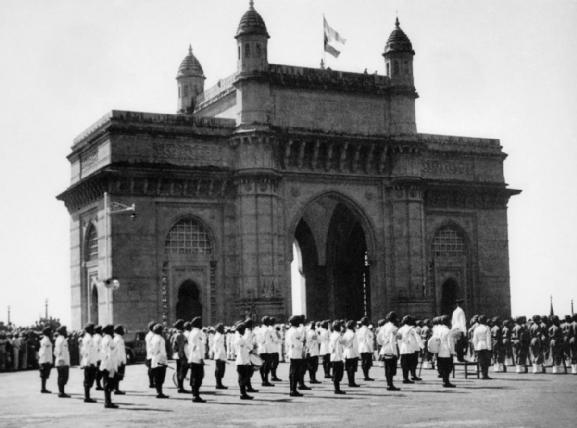
The Gateway of India is not just a monument on Mumbai’s waterfront, it is a structure that marks both the height and the end of British rule in India. Built to welcome empire, it ultimately witnessed its final departure.
Historical Context: Why It Was Built
Before the Gateway was built, Apollo Bunder functioned as a local fishing area. From 1915 to 1919, land reclamation work was carried out there to create the site for constructing the Gateway.
The Gateway of India was conceived to commemorate the visit of King George V and Queen Mary to India in December 1911, the only time a reigning British monarch visited India during the colonial period.
However, what is often overlooked is that the structure did not exist at the time of their arrival. The royal couple landed at a simple jetty. The monument was planned afterward as a ceremonial entrance to British India.
- 1911 – Visit of King George V and Queen Mary to India
- 31 March 1913 – Foundation stone laid by Sir George Sydenham Clarke (Governor of Bombay)
- 1914–1918 – World War I slows progress
- 1919 – Final design approvals and land reclamation progress
- 1920 – Construction begins in earnest
- 1924 – Monument completed and opened to the public
The delay between conception and completion reflects administrative procedures, land reclamation requirements, and architectural approvals typical of colonial infrastructure projects.
The Foundation: More Than Just a Stone
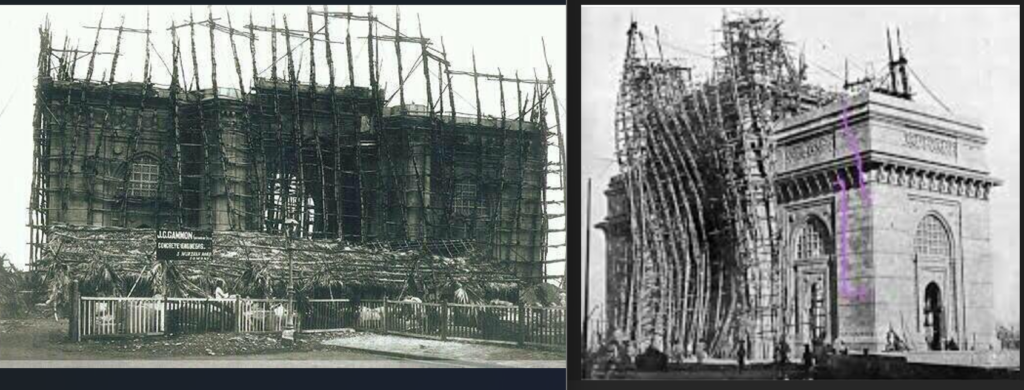
The foundation of the Gateway of India is not merely symbolic, it is structurally tied to the reclaimed land of Apollo Bunder. The site originally consisted of mud flats along the Mumbai harbour. Land reclamation was necessary before construction.
The foundation had to be reinforced to withstand marine conditions and tidal forces. This makes it not just an architectural structure but also an early example of coastal engineering in colonial India.
The foundation stone was laid by Sir George Sydenham Clarke, then Governor of Bombay.
Architectural Character: Indo-Saracenic with Gujarati Influence
The Gateway is often described as Indo-Saracenic, but that label only partially explains its design.
- Central arch height: 26 metres (85 feet)
- Built from yellow basalt and reinforced concrete
- Features Islamic arches combined with Hindu decorative motifs
- The intricate latticework reflects Gujarati architectural influence
George Wittet also designed other prominent Mumbai landmarks like the Prince of Wales Museum (now CSMVS), showing a consistent architectural vocabulary adapted to colonial needs.
Strategic and Ceremonial Role
The Gateway was not merely ornamental; it served as a ceremonial landing point for British officials arriving by sea.
Before the era of aviation, most high-ranking officials entered India through the Mumbai port. The Gateway functioned as a symbolic threshold of empire, carefully positioned to face the sea so that it would form the first visual impression of British India for arriving dignitaries.
1948: The Exit That Redefined Its Meaning
On 28 February 1948, the last British troops, the First Battalion of the Somerset Light Infantry departed India through the Gateway of India.
This moment transformed the monument’s meaning entirely. What had been constructed as a gateway for imperial entry became a point of colonial exit. Few structures in India have witnessed such a reversal of symbolism within such a short span of time.
The Surrounding Ensemble
The Gateway does not stand in isolation, and its surroundings add significantly to its historical context.
Directly opposite stands the Taj Mahal Palace Hotel (1903), built by Jamsetji Tata, which predates the Gateway itself. The area of Apollo Bunder evolved into a key maritime node during the colonial period and continues to remain active today as a departure point for ferries to the Elephanta Caves.
Conservation and Present-Day Relevance
Over the years, the monument has undergone multiple restoration efforts due to continuous exposure to sea conditions and pollution-related discoloration.
Today, the Gateway of India functions as a major tourist landmark, a public gathering space, and a site for national and civic events. Despite its popularity, the deeper narrative of the structure, rooted in empire, engineering, and historical transition, is often overlooked in casual viewing.
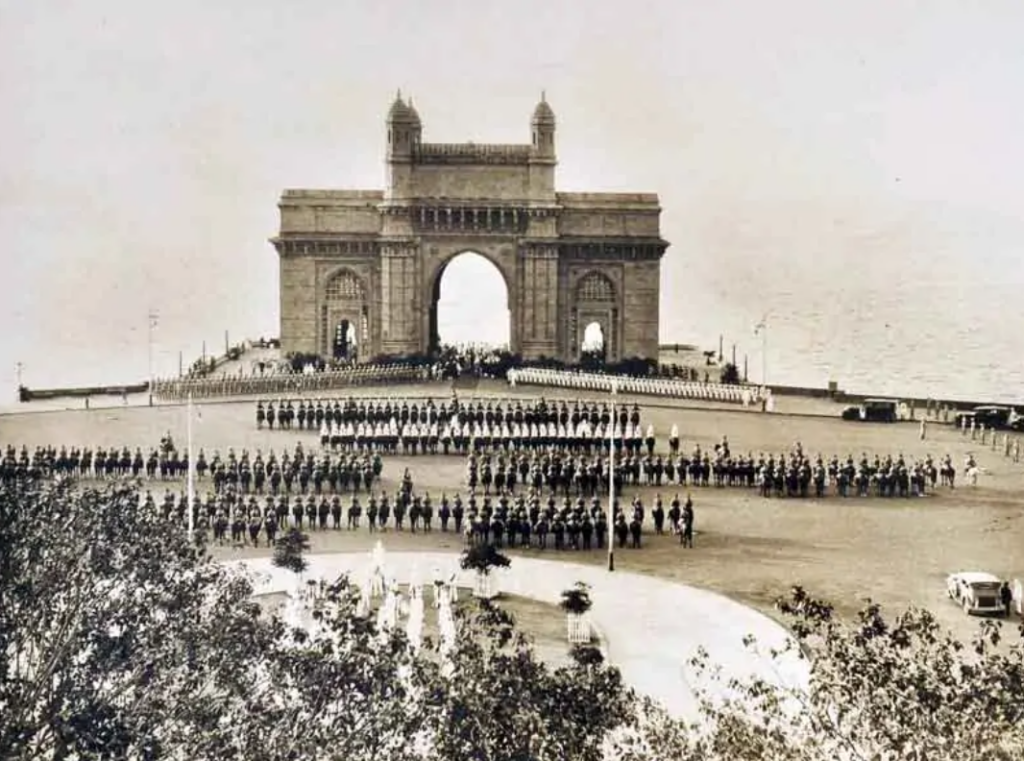
Above is the 1931 photograph (mage source: past-india.com) captures a farewell parade at the Gateway of India in Bombay (Mumbai), held in honour of the retiring Viceroy of India, Lord and Lady Irwin. The ceremony featured an impressive send-off by the British Indian military, with the relatively new Gateway of India standing prominently in the background.
How to Reach Gateway of India (Mumbai)
By Train:
The nearest railway station is Churchgate (Western Line), about 2.5 km away. By central line you can also get down at Chhatrapati Shivaji Maharaj Terminus (CSMT), which is around 3 km away.
By Bus:
Buses are the cheapest source to travel. Take any buses heading toward Colaba Depot or Electric House. Get down at Regal cinema or Museum stop.
By Taxi:
Taxis are easily available and can drop you directly. Caution taxi man might charge more, it is a minimum distance fare from Churchgate and CSTM.
By Walking:
If you are already in South Mumbai (Colaba, Fort, or near Marine Drive), the Gateway is easily accessible on foot. From Colaba Causeway, it’s about a 5–10 minute walk.








[…] bus takes off from multiple locations, the spirit of the Mumbai Darshan truly comes alive at the Gateway of India. Standing tall against the backdrop of the Arabian Sea, this monument is not just a starting point […]
Comments are closed.