
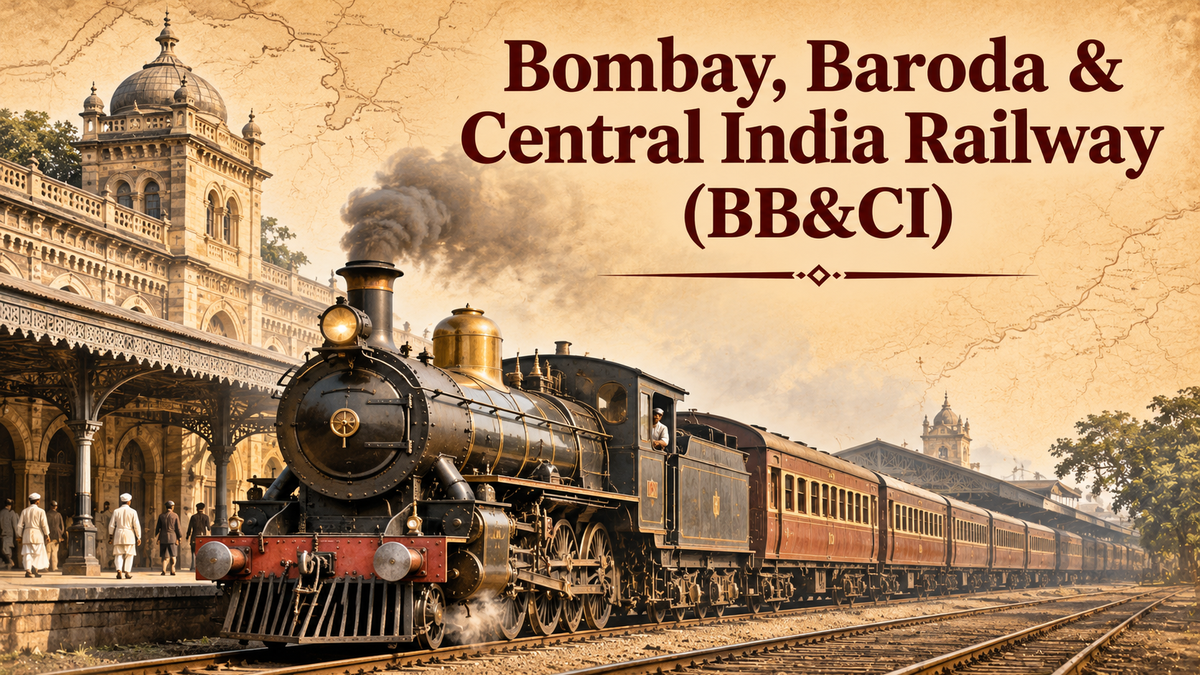
The history of Mumbai’s Western Railway suburban network goes back to the mid-19th century, when the Bombay, Baroda and Central India Railway (BB&CI) was established to connect Bombay with important commercial centres in western and northern India.
Incorporated in 1855, BB&CI gradually expanded its railway network from Gujarat towards Bombay and eventually became one of the major railway systems in western India. Apart from facilitating trade and transportation, it also laid the foundation for the suburban railway services that connect Mumbai with its northern suburbs and surrounding regions today.
The present-day Western Railway is the direct successor of BB&CI. Its historical routes continue to form an important part of Mumbai’s suburban and long-distance railway network.
Table of Contents
- Origin and Establishment
- Expansion Towards Bombay
- Birth of Mumbai’s Western Suburban Railway
- How BB&CI Connects to Today’s Railway Network
- Relevance to Mumbai Metropolitan Region (MMR)
- Important Historical Milestones
- Quick Facts
- References and Further Reading
1. Origin and Establishment
The Bombay, Baroda and Central India Railway Company was incorporated on 2 July 1855 under an Act of the British Parliament.
Its primary objective was to develop a railway connection between Bombay and important commercial centres in western India, particularly Gujarat.
The initial railway project involved constructing a broad-gauge line in Gujarat, beginning with a 29-mile stretch between Ankleshwar and Utran.
The railway was important for transporting cotton, agricultural produce and other commodities to Bombay, which was emerging as a major commercial and trading centre.
2. Expansion Towards Bombay
BB&CI gradually extended its railway network towards Bombay.
By 1864, the railway had reached Bombay, with services operating between Grant Road and Ahmedabad. This established an important railway connection between Bombay and Gujarat.
The network subsequently expanded northwards and towards central India, connecting important locations such as:
- Surat
- Baroda (Vadodara)
- Ahmedabad
- Godhra
- Ratlam
- Nagda
- Mathura
- Delhi
In 1896, BB&CI reached Delhi, establishing a connection with the Great Indian Peninsula Railway network at Mathura.
This expansion strengthened Bombay’s position as a major commercial gateway for western and northern India.
3. Birth of Mumbai’s Western Suburban Railway
One of BB&CI’s most significant contributions was the development of suburban railway services in Bombay.
On 12 April 1867, the first suburban local service operated between Virar and Back Bay, with one train in each direction.
Back Bay was located in the southern part of present-day Mumbai, between the Churchgate and Marine Lines areas.
The service was subsequently extended to Churchgate, which opened as a railway station in 1870. The railway line was further extended to Colaba in 1873.
As Bombay expanded, the suburban railway gradually became an essential mode of transport for people travelling between the northern settlements and the growing commercial districts of South Bombay.
Introduction of electric trains
A major transformation took place on 5 January 1928, when the first electric suburban train on the Western Railway network operated between Colaba and Borivali.
The electrification of the suburban corridor marked an important step towards modern commuter transportation.
In 1930, Colaba station was closed, and Churchgate became the southern terminus of the suburban network.
The railway corridor subsequently expanded northwards, eventually reaching Dahanu Road in 2013.
4. How BB&CI Connects to Today’s Railway Network
Following India’s independence, the railway system underwent major administrative reorganisation.
On 5 November 1951, Western Railway was formed through the merger of BB&CI with several other railway systems, including Saurashtra, Rajputana and Jaipur.
Thus, BB&CI became the principal predecessor of the present-day Western Railway.
Its historical railway corridor continues to serve two important purposes:
1. Suburban transportation: The Churchgate–Mumbai Central–Borivali–Virar–Dahanu Road corridor serves Mumbai’s extensive suburban commuter network.
2. Long-distance transportation: The railway routes extending northwards from Mumbai connect Maharashtra with Gujarat, Rajasthan, Delhi and other parts of western and northern India.
It is important to note that Mumbai’s Central Railway has a separate historical origin, tracing its lineage to the Great Indian Peninsula Railway (GIPR), which operated India’s first passenger train between Bombay and Thane in 1853.
5. Relevance to Mumbai Metropolitan Region (MMR)
The contribution of BB&CI extends beyond the development of Mumbai city. Its railway corridor laid the foundation for the northward expansion of suburban connectivity.
The present Western Railway suburban network connects important urban and suburban centres, including:
- Churchgate
- Mumbai Central
- Dadar
- Bandra
- Andheri
- Borivali
- Bhayandar
- Vasai Road
- Virar
- Dahanu Road
These connections have supported residential development, industrial growth, commercial activity and daily commuting across Mumbai and its surrounding region.
Its relationship with modern MMR transport
The railway infrastructure developed by BB&CI forms part of the existing Western Railway system. However, modern transport development in the Mumbai Metropolitan Region involves several different agencies.
- Western Railway: Operates suburban and long-distance railway services on its network.
- Central Railway: Operates the Central and Harbour suburban railway corridors.
- Mumbai Railway Vikas Corporation (MRVC): Implements railway infrastructure and capacity-enhancement projects under Mumbai Urban Transport Projects (MUTP).
- MMRDA: Plans and implements major metropolitan transport infrastructure, particularly Metro projects.
Modern initiatives such as additional railway lines, corridor expansion, station improvements and Metro connectivity are aimed at addressing the growing transportation requirements of the region.
The historical BB&CI corridor therefore remains an important foundation of Mumbai’s present-day rail-based transport system.
6. Important Historical Milestones
| Year | Development |
|---|---|
| 1855 | BB&CI Railway incorporated |
| 1860 | Initial railway section between Ankleshwar and Utran inaugurated |
| 1864 | Railway extended to Bombay |
| 1867 | Suburban service introduced between Virar and Back Bay |
| 1870 | Churchgate railway station opened |
| 1873 | Railway line extended to Colaba |
| 1896 | BB&CI reached Delhi |
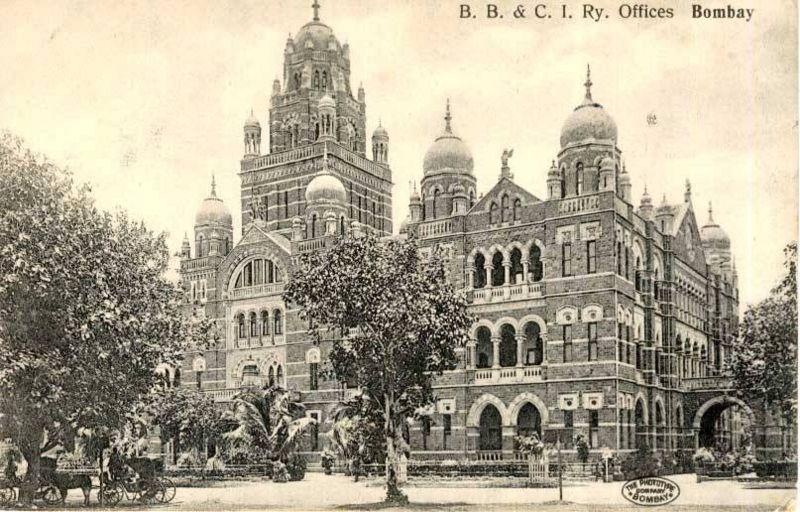
| 1899 | BB&CI headquarters building at Churchgate completed |
| 1928 | First electric suburban train operated between Colaba and Borivali |
| 1930 | Colaba station closed; Churchgate became the suburban terminus |
| 1951 | Western Railway formed on 5 November |
| 2013 | Western suburban services extended to Dahanu Road |
7. Quick Facts
| Particulars | Information |
|---|---|
| Full name | Bombay, Baroda and Central India Railway |
| Established | 1855 |
| Initial route | Ankleshwar–Utran |
| Railway gauge | Broad gauge for the initial main line |
| Reached Bombay | 1864 |
| First suburban service | Virar–Back Bay, 1867 |
| Churchgate station opened | 1870 |
| Reached Delhi | 1896 |
| Headquarters | Churchgate, Bombay |
| Successor | Western Railway |
| Western Railway formation | 5 November 1951 |
Also read:
8. References and Further Reading
- Western Railway – About Us: Official history of BB&CI and the formation of Western Railway.
- Western Railway – Historical Milestones: Important dates relating to the development of the railway network and suburban services.
- Municipal Corporation of Greater Mumbai – Tourism Development Plan: Background on the development of Mumbai’s railway network and BB&CI.
- Mumbai Metropolitan Region Development Authority – Mumbai Metro Overview: Information on the development of metropolitan rail-based transport.
- Mumbai Railway Vikas Corporation – Corporate Plan: Information on the suburban railway network and infrastructure development.
Memumbai.com | Exploring the history, heritage and places of Mumbai.