
Mumbai is racing towards development. New roads, sea links and coastal infrastructure promise faster travel and economic growth. But in this race, the city is silently losing one of its strongest natural protectors, Mangroves.
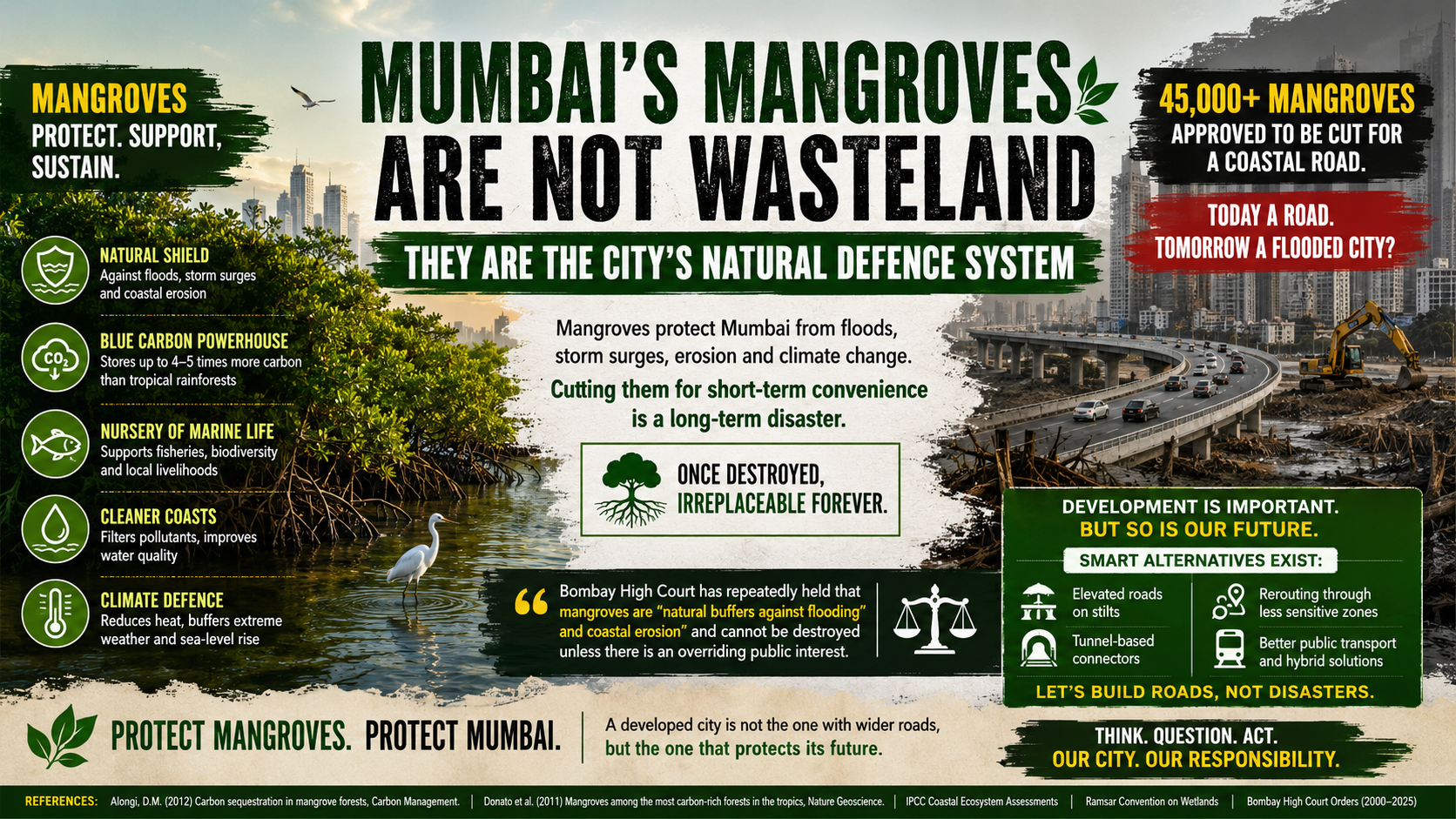
The recent approval to cut nearly 45,000 mangroves for the Versova–Bhayandar Coastal Road has triggered concern among environmentalists, scientists and coastal communities. Even the Bombay High Court acknowledged that mangroves are “natural buffers against flooding and coastal erosion” and cannot be destroyed unless there is an overriding public interest.
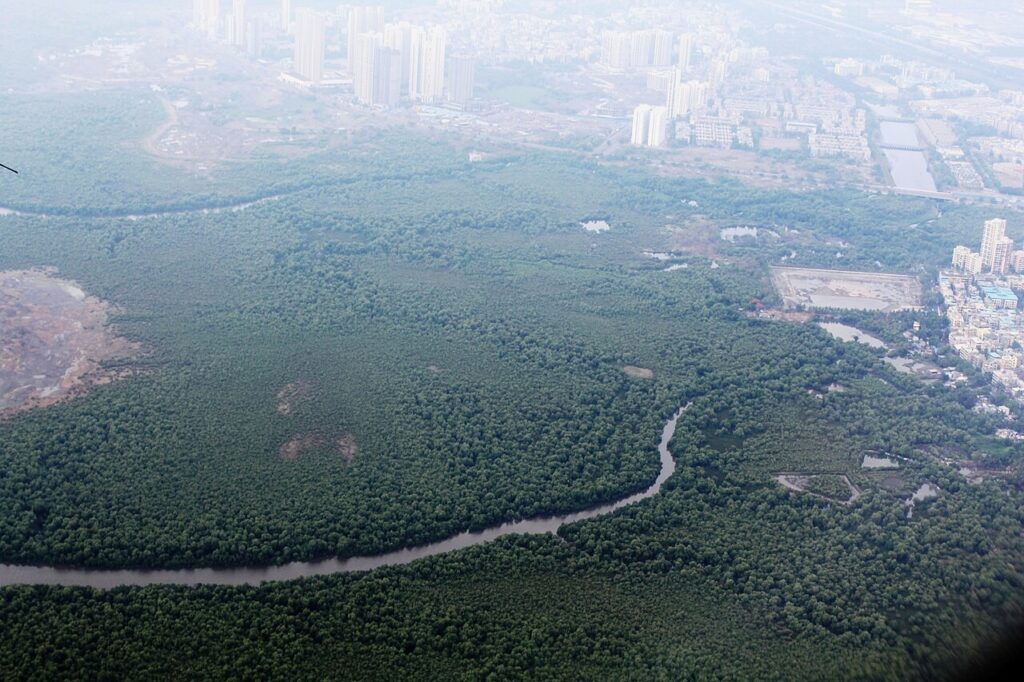
Mangroves are not ordinary trees
Mangroves dense roots absorb wave energy, slow down floodwater and stabilize the coastline naturally. In a city already suffering from severe flooding during high tides and intense rainfall, weakening this natural shield may prove dangerous in the long term. They protect Mumbai from:
tidal flooding,
storm surges,
coastal erosion,
sea-level rise,
extreme monsoon impacts.
Scientists worldwide recognize mangroves as one of the planet’s most powerful “Blue Carbon” ecosystems because they absorb and store massive amounts of carbon dioxide. They also serve as breeding grounds for fish, crabs and marine biodiversity that support local fishing communities.
After the 2004 tsunami, scientific studies showed that coastal regions protected by mangroves suffered significantly less destruction. International bodies such as the Ramsar Convention, IUCN and UN climate panels strongly advocate strict mangrove conservation.
Ironically, courts in India have repeatedly protected mangroves for years. Earlier Bombay High Court orders treated mangrove destruction as a serious ecological violation and imposed strict restrictions on construction in such areas. ()
The real question is not “development versus environment.”
The real question is:
Can development happen without destroying irreplaceable natural protection systems?
Alternative engineering solutions were possible:
– elevated roads on stilts,
– tunnel-based coastal connectors,
– rerouting through less sensitive zones,
– hybrid transport corridors,
– improved public transport integration.
Even environmental groups and former judges suggested elevated alignments to reduce mangrove destruction.
Mumbai must understand one critical reality:
Concrete walls can be rebuilt.
Collapsed ecosystems cannot.
Today, mangroves are being cut for convenience. Tomorrow, the same city may spend thousands of crores fighting floods, erosion and climate disasters that these mangroves naturally prevented for free.
“A developed city is not the one with only wider roads. A truly developed city is one intelligent enough to protect its future while building its present.“
The irony is painful:
Cities are spending billions trying to fight climate change while simultaneously destroying ecosystems that naturally perform the same task for free.
Protecting mangroves is not anti-development. It is intelligent development rooted in long-term survival.
Example: What Happened in Other Countries?
Wetlands Protecting Southeast Louisiana
Field studies indicate that coastal marsh vegetation significantly impacts wave attenuation, as measured by reductions in wave height per unit distance across a wetland. Such evidence is often cited to support marsh restoration globally for the purpose of protecting low-lying coastal communities and property from hurricanes and storms. For example, global assessments of coastal wetland loss in temperate zones urge marsh restoration as a priority in protecting coastlines
Here is the link for one of the research studies Wetlands Protecting Southeast Louisiana
Also Before Hurricane Katrina, massive coastal wetlands and marshes had already been destroyed for urban expansion and canals. Scientists later concluded that the loss of wetlands worsened flooding and storm surge devastation during the disaster.
Billions were later spent trying to rebuild artificial flood protection systems that natural ecosystems once provided almost free.
Indonesia & Thailand
After the 2004 tsunami, villages protected by mangrove belts suffered significantly less destruction compared to exposed coastlines.
This became one of the strongest scientific proofs that mangroves act as natural disaster barriers.
Therefore, there is no true substitute for mangroves, and Mumbai may ultimately pay a heavy price for sacrificing them in the name of comfort and development. Time alone will reveal the consequences that the near future holds.
About the study of Indonesia Tsunami
Also read – What is Blue Carbon?
Related article:
The environmental costs of replacing mangroves with a road