

Most people think forests are the planet’s biggest weapon against climate change.
But few realize that coastal ecosystems like mangroves store carbon far more efficiently than many terrestrial forests. This stored carbon is called Blue Carbon.
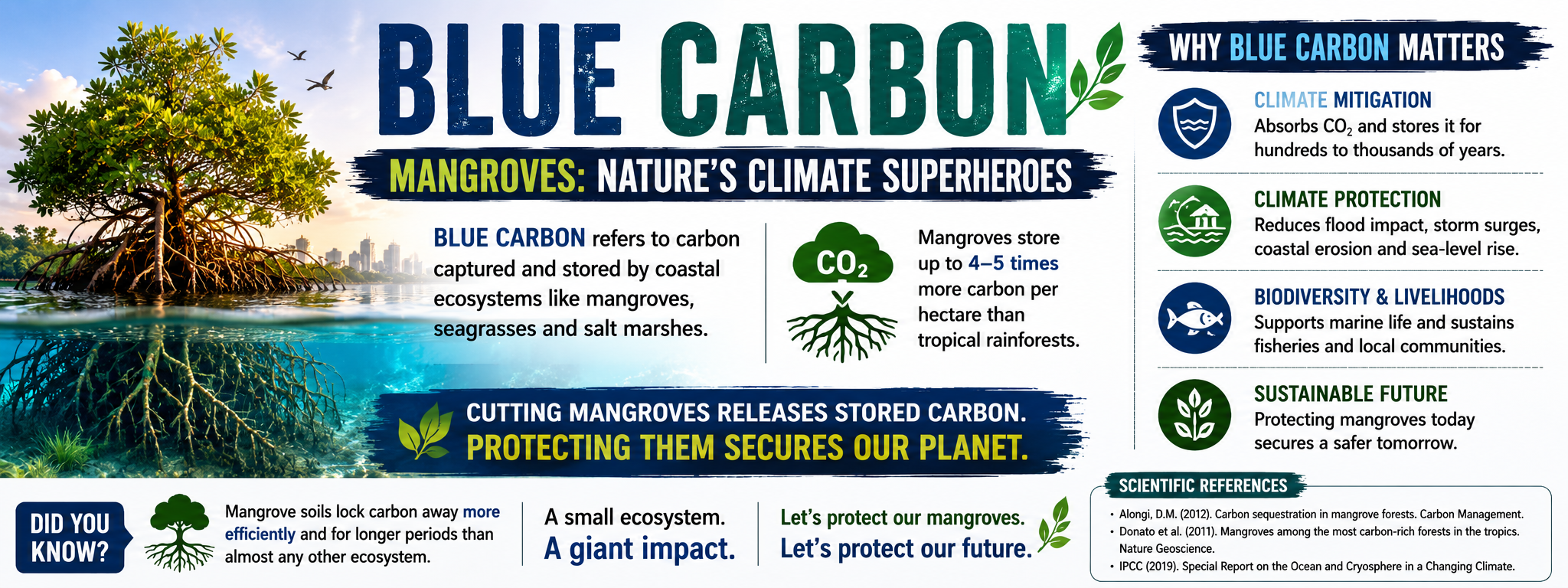
Blue Carbon refers to the carbon captured and stored by:
mangroves,
seagrasses,
salt marshes,
coastal wetlands.
Among them, mangroves are considered one of the most powerful natural carbon sinks on Earth.
Why Mangroves Are Called “Blue Carbon Ecosystems?”
Mangroves absorb carbon dioxide (CO₂) from the atmosphere through photosynthesis. But unlike ordinary forests, they store carbon in:
– trunks and leaves,
– massive underground root systems,
– deep coastal sediments beneath them.
These waterlogged sediments trap carbon for hundreds to thousands of years.
Scientists have found that mangroves can store up to 4–5 times more carbon per hectare than tropical rainforests. Once destroyed, this stored carbon is released back into the atmosphere, accelerating global warming.
This means cutting mangroves does not only remove trees — it can convert a major carbon storage system into a carbon emission source.
Why Blue Carbon Matters for Mumbai?
For coastal cities like Mumbai, Blue Carbon ecosystems provide double protection:
They reduce climate change by absorbing CO₂.
They protect the city from the impacts of climate change such as flooding, storm surges and sea-level rise.
This makes mangroves both:
– a climate mitigation syste
– and a climate defence system.
As sea levels rise and extreme rainfall events become more frequent, preserving mangroves becomes not just an environmental issue, but an urban survival strategy.
Global Recognition of Blue Carbon
Blue Carbon is now a major topic in:
– UN Climate Change discussions,
– IPCC climate reports,
– Ramsar wetland conservation frameworks,
i- International carbon credit systems.
Countries across the world are restoring mangroves because they are considered one of the cheapest and most effective nature-based solutions for climate resilience.
Scientific Studies Supporting Blue Carbon:
– Alongi, D.M. (2012) – Carbon sequestration in mangrove forests – Published in Carbon Management.
– Donato et al. (2011) – Mangroves among the most carbon-rich forests in the tropics – Published in Nature Geoscience.
– IPCC Coastal Ecosystem Assessments – Recognize mangroves as globally important carbon sinks and climate adaptation systems.








[…] Also read – What is Blue Carbon? […]
Comments are closed.