
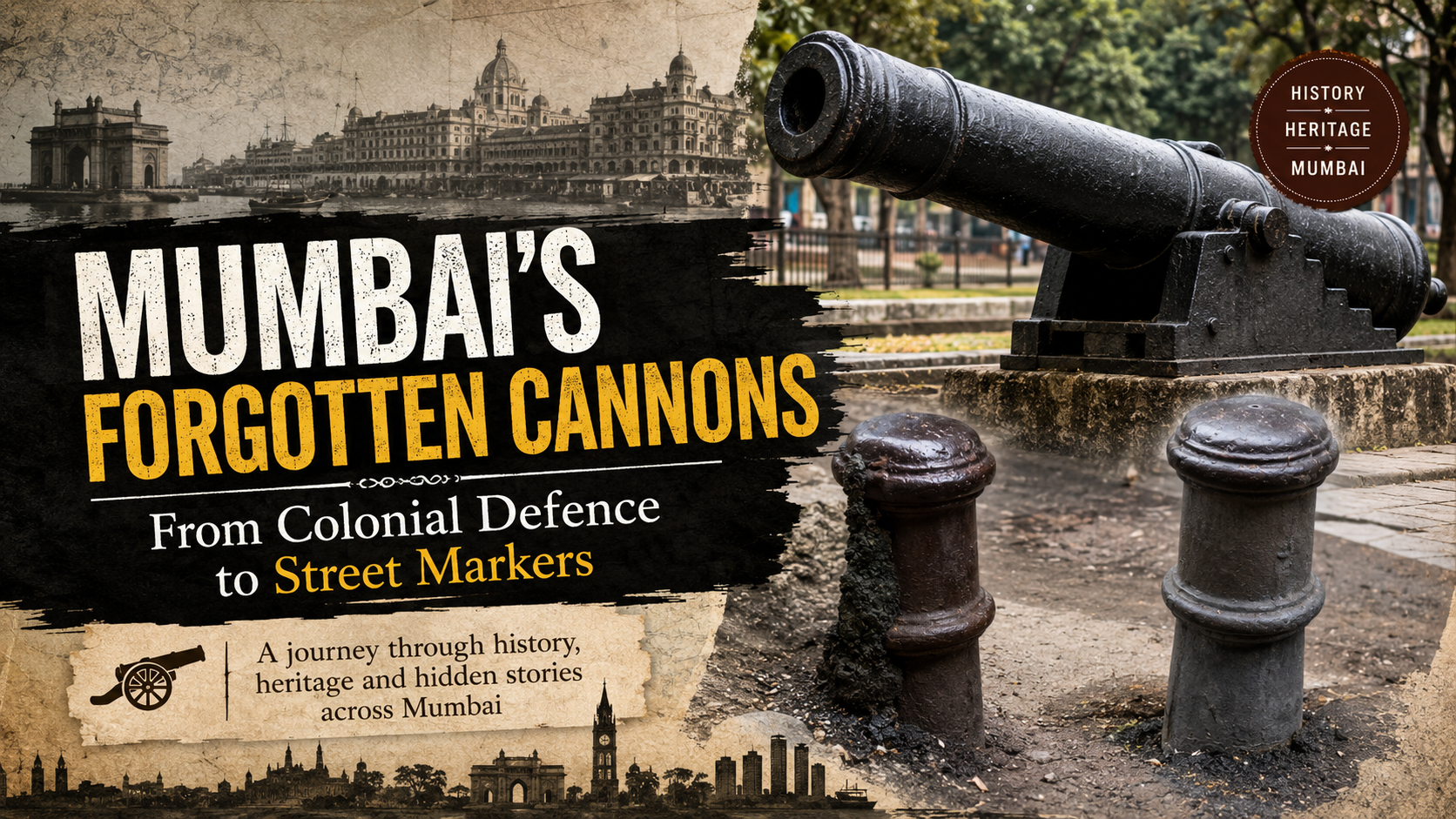
Mumbai’s streets still hide a surprising number of old cannons dating from the colonial period. Some stand in parks today as restored heritage objects, while others remain almost unnoticed—buried in the ground, incorporated into shopfronts or used as street bollards.
These cannons broadly belong to two different stories: artillery associated with the defence of Bombay, and obsolete cannons that were later reused as markers and bollards as the city expanded.

Contents
Cannons built for the defence of Bombay
The clearest documented examples are two large cast-iron cannons discovered at Lions Children’s Park in Ghatkopar. The cannons had been lying in poor condition and were partly buried in marshy soil before being discovered and taken up for restoration by the Brihanmumbai Municipal Corporation’s Heritage Cell.
The cannons are 3.10 metres long and date to 1856. Both carry the inscription “NCPC” in Roman letters. They are associated with the East India Company period and each weighs approximately five tonnes.
After restoration, one cannon was placed at Lions Children’s Park and the other was moved to Dr Keshav Baliram Hedgewar Park in Ghatkopar. The restoration included cleaning the ironwork, recreating the gun carriage and mounting the cannons on specially constructed platforms.
Their exact journey to Ghatkopar, however, remains unknown. There is no surviving record establishing when or why they were brought to the particular garden where they were found. Popular accounts sometimes describe such cannons as having been used directly to defend Mumbai, but the available reporting does not establish the precise operational history of these individual guns.
The Ghatkopar cannons therefore provide one of the strongest documented examples of Mumbai’s colonial artillery heritage: their age, material, dimensions and inscriptions are physically verifiable.
Cannons that became street markers
A very different group of cannons can still be found in parts of old South Mumbai.
These are generally smaller and are often found standing vertically or lying partly buried in the ground. Rather than continuing as military weapons, some appear to have been reused as bollards, boundary markers or street furniture.
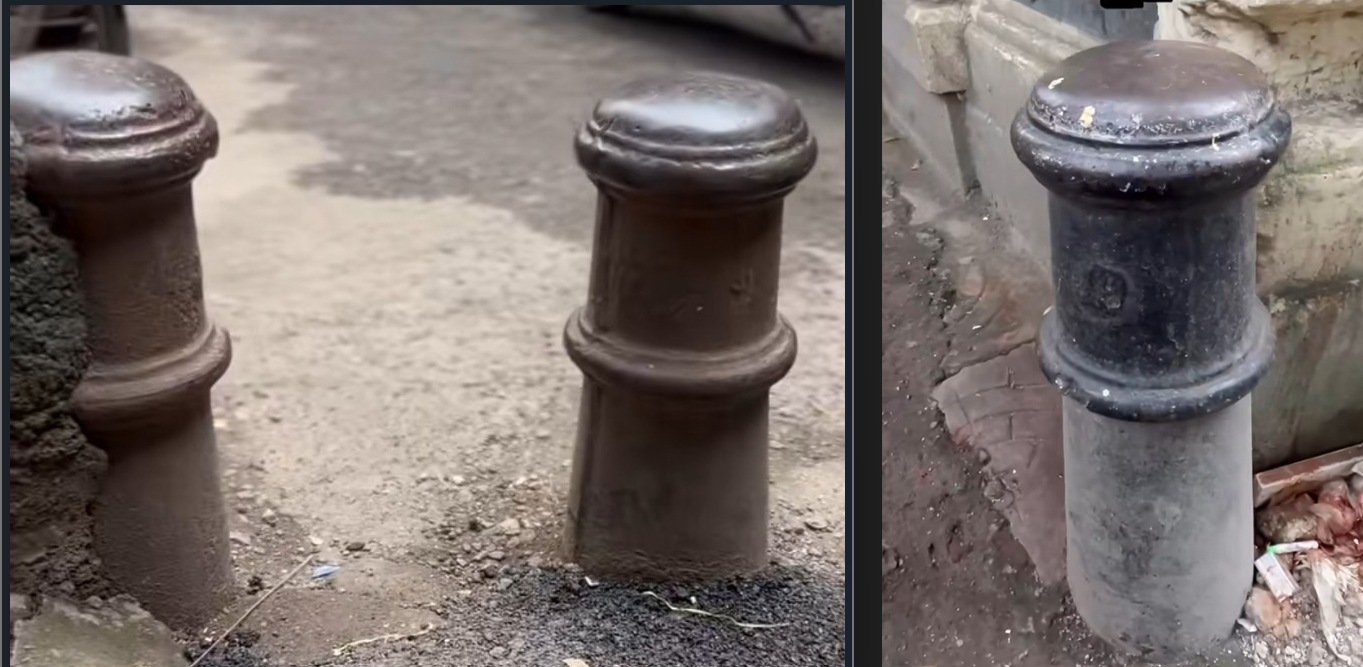
A 2017 investigation by Mumbai Mirror, carried out with Mumbai heritage researchers Bharat Gothoskar and Vinayak Talwar, documented examples around Bhandari Street, Nagdevi Street, Sarang Street and Lokmanya Tilak Marg. Researchers suggested that some of these cannons may have been installed around the 1850s, when older artillery had become obsolete. They were apparently being used as markers rather than for military purposes, and may also have provided convenient posts around which horses could be tied.
At Bhandari Street, near Masjid Bunder, one particularly unusual cannon was found buried upside down. A small shrine has since been built around it and the object is worshipped by the local community. Other cannons were reported nearby, lying on the street and apparently having served as bollards.
Other examples were recorded at the entrance to Nagdevi Street, where cannons had become almost completely hidden beneath shops, and at Sarang Street, where a cannon had been incorporated into the entrance of a restaurant. Additional examples were documented around Lokmanya Tilak Marg, including cannons near the police station.
Did the cannons mark the boundary of “White Bombay”?
This is one of the most interesting—and also one of the most frequently simplified—parts of the story.
Heritage researchers have suggested that some of these cannon markers were associated with the boundary between the European settlement in the Fort area and the expanding Native Town to its north.
The historical existence of this distinction is well established. A heritage survey of C Ward describes the area within the Fort as the English settlement and the area north of present-day Lokmanya Tilak Marg, formerly Carnac Road, as the developing Native Town. The devastating fire of 1803 also encouraged Indian merchants and residents to move north of the Fort and build houses, shops and warehouses there.
Why are they so difficult to recognise?
Many of these cannons have disappeared into Mumbai’s changing streetscape.
Some were painted, partly buried or covered with cement. Others became incorporated into shopfronts. In some places they were mistaken for old water hydrants or simply treated as ordinary street objects.
A heritage survey conducted in 2019 found cannons hidden beneath shops and in narrow lanes around the old city. Researchers had to rely partly on information from local residents and older inhabitants to locate them.
This helps explain why Mumbai does not have a simple, definitive list of all its surviving colonial cannons.
In 2017, the then Director of Maharashtra’s Directorate of Archaeology and Museums, Dr Tejas Garge, estimated that Mumbai could have as many as 250 old cannons that might be preserved and displayed. This should be understood as an estimate rather than a confirmed inventory of 250 surviving cannons.
Two cannons, two very different histories
The contrast between the Ghatkopar cannons and the small street cannons is what makes Mumbai’s cannon heritage particularly interesting.
The Ghatkopar examples are substantial pieces of mid-19th-century cast-iron artillery, with a clearly marked date of 1856 and physical evidence that can be examined today.
The smaller cannons scattered around old South Mumbai tell a different story. They appear to have outlived their usefulness as weapons and were subsequently absorbed into the city’s streetscape—as bollards, markers and other forms of street infrastructure.
Some have even acquired new identities. The inverted cannon at Bhandari Street, for example, is no longer simply an old piece of artillery; it has become a local shrine and part of the living heritage of the neighbourhood.
Together, these objects provide a fascinating glimpse into Bombay’s transformation from a colonial fortified settlement into the densely built city that became Mumbai.
References and image sources
- Mumbai Mirror — “On the cannon trail”, 3 June 2017. Field investigation of surviving street cannons and their historical interpretation.
Read the article - Heritage Chronicles — “In search of British era cannon’s in streets of old Bombay”. Field documentation of several street cannons, including Bhandari Street, Nagdevi Street, Sarang Street and Lokmanya Tilak Marg.
Read the field survey - The Indian Express — “BMC restores two 167-yr-old cannons unearthed in Ghatkopar garden”, 2023. Details of the Ghatkopar cannons, their 1856 date, dimensions and restoration.
Read the report - Hindustan Times — “BMC to restore British-era cannons to past glory”, 2022. Details concerning the Ghatkopar cannons and the uncertainty surrounding their arrival at the garden.
Read the report - Wikimedia Commons — “Cannon at Fort George, Mumbai 05.jpg”. Photograph by Pratish Khedekar, licensed CC BY-SA 4.0. The image is used here as an illustrative Mumbai cannon photograph, not as one of the Ghatkopar 1856 cannons.
Image and licence details - Atlas Obscura — “Cannon Shrine”, published 2026. Present-day documentation of the Bhandari Street inverted cannon shrine and its location, with links to earlier Mumbai heritage sources.
View the listing