
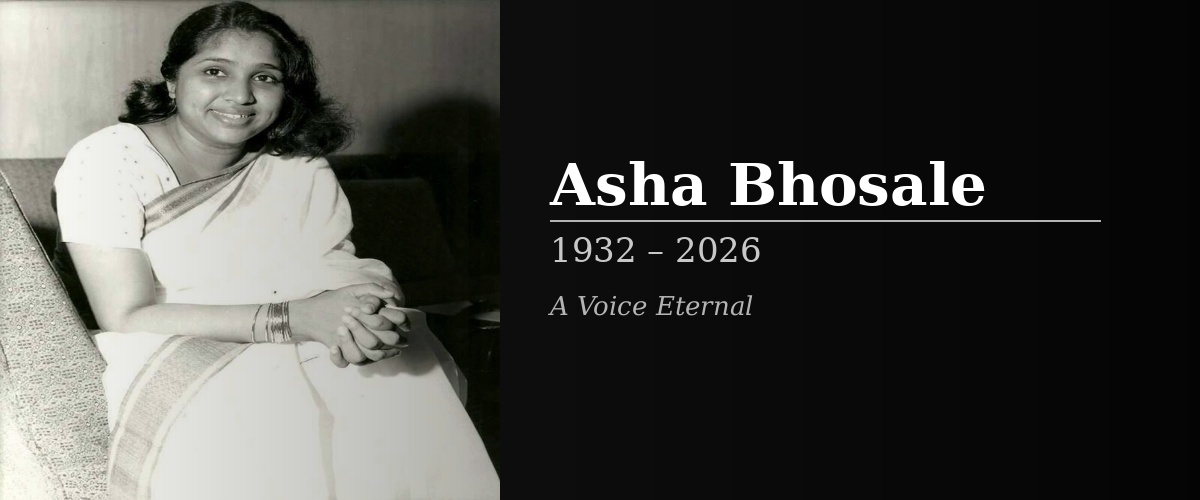
There are singers who follow music, and then there are those whose life becomes music itself. Asha Bhosle belongs to the second kind, a voice shaped not just by training, but by experience, struggle, and relentless passion.
Born into Music, Raised by Life
Ashalata Dinanath Mangeshkar was born in a small hamlet called Goar in Sangli, then part of a princely state (now in Maharashtra). She was born into a deeply musical household. Her father, Deenanath Mangeshkar, was a respected classical singer and stage actor, while her mother Shevanti came from a Gujarati background.
Music was everywhere but stability was not. When Asha was just nine years old, her father passed away. The loss was not just emotional it shook the family’s foundation. They moved from Pune to Kolhapur and eventually to Mumbai, searching for survival. Childhood ended early.
When Survival Became a Calling
To support the family, Asha and her elder sister Lata Mangeshkar stepped into films singing and acting at a very young age. Her first recorded song came in Marathi “Chala Chala Nav Bala” for the film Majha Bal (1943), composed by Datta Davjekar. She entered Hindi cinema with “Saawan Aaya” from Chunariya (1948), composed by Hansraj Behl. Around the same time, she also sang for Andhon Ki Duniya.
Her first solo Hindi song followed soon after in Raat Ki Rani (1949).
Years later, she would even lend her voice to Assamese cinema with “Pokhiraj Ghora” in Sikimik Bijuli (1969), alongside legends like Kishore Kumar and Bhupen Hazarika.
A Musical Family
Asha Bhosle was born into one of India’s most remarkable musical families, where talent flowed naturally across generations. Her father, Deenanath Mangeshkar, laid the foundation with his deep roots in classical music and theatre. Among her siblings, Lata Mangeshkar became a legendary voice in Indian cinema, while Usha Mangeshkar also made her mark as a playback singer. Her sister Meena Mangeshkar contributed as a music director, and her brother Hridaynath Mangeshkar earned respect as a composer known for his classical depth. Growing up in such an environment, music was not just a profession for Asha it was a shared legacy, a family language, and a lifelong bond that shaped her journey.
Learning Beyond Classrooms
Formal education took a backseat in her life. But what she lacked in schooling, she gained in immersion. Asha Bhosle often described herself as an “accidental singer.” She learned by observing—her father, his disciples, and especially her sister Lata. Her discipline was unmatched. She continued her daily riyaaz (practice) throughout her life. For her, music wasn’t a profession. It was as essential as breathing.
Early Career: The Phase of Being Overlooked
The late 1940s and early 1950s were dominated by voices like Geeta Dutt, Shamshad Begum, and Lata Mangeshkar. Asha often found herself singing for smaller, low-budget films.
But here’s what made her different. She didn’t reject these opportunities. She used them. In fact, during the 1950s, she sang more songs than most playback singers, quietly building her craft.
Finding Identity Through Collaboration
Her breakthrough came with O. P. Nayyar, who recognized her distinct voice and gave her songs that carried attitude, expression, and boldness. Later, her creative partnership with R. D. Burman transformed Hindi film music. Together, they experimented fearlessly bringing in rhythm, western influences, and fresh energy.
Interestingly, Asha Bhosle herself credited artists like Elvis Presley and Bill Haley for inspiring her to explore western styles.
Wider Collaborations That Defined an Era
Over the decades, she worked with some of the finest composers in Indian cinema, including:
- S. D. Burman
- Khayyam
- Ravi
- Jaidev
- Anu Malik
- A. R. Rahman
Each collaboration revealed a new shade of her voice from classical to cabaret, ghazal to pop.
Achievements That Go Beyond Numbers
Asha Bhosle’s career spans over eight decades, an extraordinary journey. Her achievements include:
2 National Film Awards
9 Filmfare Awards + Lifetime Achievement
Record 7 Filmfare Awards for Best Female Playback Singer
18 Maharashtra State Film Awards
2 Grammy nominations
Dadasaheb Phalke Award (2000)
Padma Vibhushan (2008)
Recognition by Guinness World Records (2011) as the most recorded artist
But beyond awards, her greatest achievement is this: She remained relevant across generations.
Click here for more detailed information about her career and songs
Also read about Lata Mangeshkar








[…] Read in english […]
Comments are closed.