


In This Article
- From Rainfall to Reservoirs
- Water Begins Its Journey
- The Long Journey to Mumbai
- Making Water Safe to Drink
- Storage and Distribution Across the City
- The Final Journey to Your Home
- Meeting the Challenges of Tomorrow
- Frequently Asked Questions
From Rainfall to Reservoirs
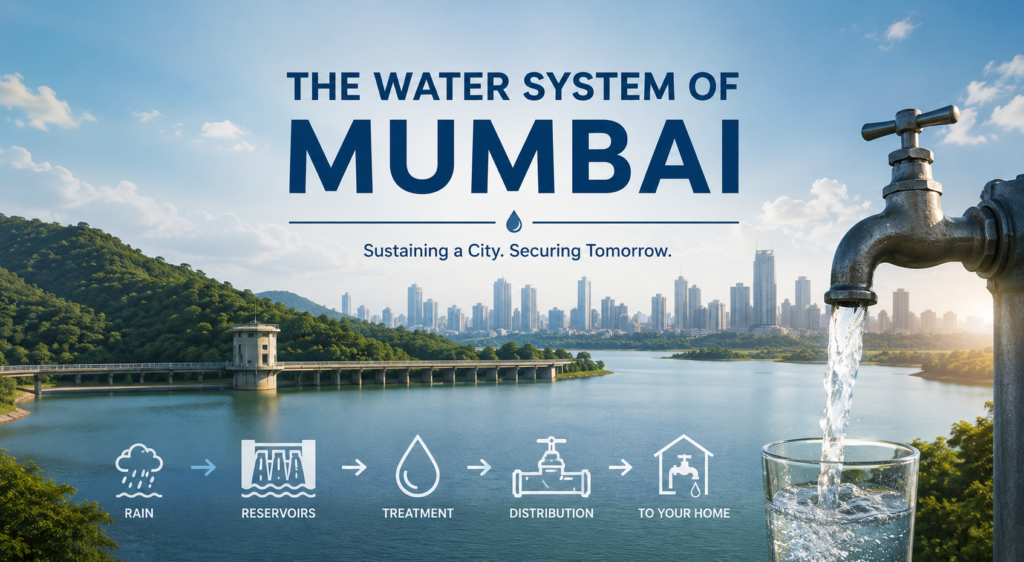
Every year, Mumbai’s water story begins with the Southwest Monsoon. Between June and September, heavy rainfall over the catchment areas of the Western Ghats and adjoining river basins replenishes the reservoirs that supply the city. Unlike many cities that depend on rivers flowing throughout the year, Mumbai stores monsoon rain for use during the remaining eight months. The seven reservoirs together have a live storage capacity of around 14.47 lakh million litres, making them the city’s natural water bank. The Brihanmumbai Municipal Corporation (BMC) closely monitors rainfall and reservoir levels throughout the monsoon, as these determine the city’s water availability for the following year.Water Begins Its Journey
Mumbai receives drinking water from seven reservoirs—Bhatsa, Middle Vaitarna, Upper Vaitarna, Modak Sagar, Tansa, Vihar and Tulsi. Among these, Bhatsa Reservoir is the largest contributor to the city’s daily water supply, while Middle Vaitarna, commissioned in 2014, is the newest addition to the network. Depending on storage levels and operational requirements, water is released from these reservoirs into large transmission mains that carry it towards Mumbai. The release is carefully regulated to ensure adequate supplies throughout the year, especially before the arrival of the next monsoon.The Long Journey to Mumbai
Once released from the reservoirs, water begins travelling towards Mumbai through a vast network of underground tunnels, aqueducts and large-diameter pipelines. Some of these pipelines measure more than three metres in diameter, allowing millions of litres of water to flow every hour. Wherever possible, gravity is used to move water naturally, reducing the need for pumping and saving energy. At locations where the terrain rises, powerful pumping stations lift the water to the next stage of the system. Depending on the source reservoir, the journey to Mumbai can range from about 25 kilometres to nearly 175 kilometres.Making Water Safe to Drink
Before reaching consumers, raw reservoir water undergoes a series of treatment processes to remove impurities and ensure it meets drinking water standards. The treatment process generally includes: • Screening to remove floating debris. • Coagulation and sedimentation to separate suspended particles. • Rapid sand filtration for improved clarity. • Disinfection to eliminate harmful microorganisms. Much of Mumbai’s water is treated at the Bhandup Water Treatment Complex, one of the largest facilities of its kind in Asia, along with other treatment plants such as Panjrapur, Vihar and Tulsi. Before being supplied, treated water is regularly tested to comply with the Bureau of Indian Standards (IS 10500) for drinking water quality. \Storage and Distribution Across the City
After treatment, water is stored in service reservoirs strategically located across Mumbai. These reservoirs act as balancing stations, ensuring a steady supply even when demand fluctuates during the day. From there, water flows through thousands of kilometres of underground distribution pipelines that reach residential areas, commercial establishments and industrial zones. To maintain equitable distribution and adequate pressure across the city, some neighbourhoods receive water according to scheduled supply timings.The Final Journey to Your Home
The last stage of the journey takes water from municipal pipelines into individual buildings. In most apartment complexes, water first enters an underground storage tank before being pumped to an overhead tank. Gravity then distributes it through internal plumbing to kitchens, bathrooms and other outlets. While BMC supplies treated drinking water up to the property connection, maintaining clean storage tanks and internal plumbing is the responsibility of housing societies and property owners. Regular cleaning of overhead and underground tanks helps preserve water quality.Meeting the Challenges of Tomorrow
Supplying water to a growing megacity is an ongoing challenge. Rising demand, ageing infrastructure, climate variability and transmission losses require continuous investment and planning. To strengthen the system, Mumbai is replacing old pipelines, introducing smart monitoring technologies and pursuing new water supply projects such as Gargai and Pinjal. Desalination and water recycling are also being explored as supplementary sources to improve long-term water security. While new projects are important, responsible water use and conservation remain equally essential to ensure that future generations continue to receive a reliable supply of safe drinking water.Frequently Asked Questions
How far does Mumbai’s drinking water travel? Depending on the reservoir, water travels approximately 25 to 175 kilometres before reaching Mumbai. Which reservoir supplies the largest share of Mumbai’s water? Bhatsa Reservoir is the largest contributor to Mumbai’s municipal water supply. Is reservoir water supplied directly to homes? No. Water undergoes treatment and quality testing before entering the distribution network. Why does Mumbai receive water at fixed timings? Scheduled supply helps maintain pressure and ensures fair distribution across different parts of the city. Can rainwater harvesting replace Mumbai’s reservoirs? No. Rainwater harvesting is an important supplementary measure but cannot meet the city’s enormous daily water demand on its own. Can seawater be used during a water shortage in Mumbai? Yes. Seawater can be converted into drinking water through desalination, but the process is expensive and requires significant energy. Since Mumbai receives abundant monsoon rainfall, water from its seven reservoirs remains the most economical and reliable source. However, BMC has proposed a desalination plant at Manori to supplement the city’s water supply during future shortages and reduce dependence on rainfall.Explore More About Mumbai’s Water Supply System
Continue learning about how Mumbai stores, treats and supplies drinking water through our detailed guides.
Sources • Brihanmumbai Municipal Corporation (BMC) – Water Supply Department • BMC Environment Status Reports • Government of Maharashtra – Water Resources Department • Central Water Commission • Bureau of Indian Standards (IS 10500 – Drinking Water Specification)
Facebook Comments

