


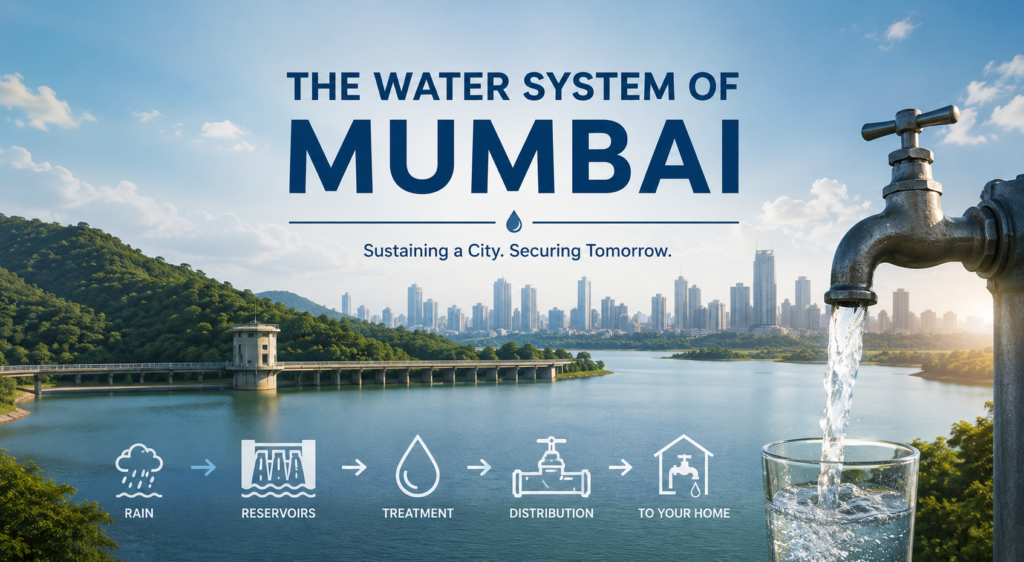
Every year, as dark monsoon clouds gather over the Western Ghats, they bring far more than just rain to Mumbai—they replenish the reservoirs that supply drinking water to millions of people. While heavy showers within the city often grab headlines, the future of Mumbai’s water supply depends primarily on rainfall received in the catchment areas of its seven lakes and reservoirs located outside the city. A good monsoon ensures sufficient water for the entire year, whereas poor rainfall can result in water conservation measures and restrictions. Understanding how these reservoirs are filled helps explain why reservoir levels are closely watched throughout the monsoon season.
In This Article
Why the Monsoon is Mumbai’s Lifeline
Unlike many cities that depend on perennial rivers, Mumbai stores most of its annual drinking water during the four-month Southwest Monsoon season from June to September. Nearly the entire water requirement for the following year depends on how much rain falls over the reservoir catchments during this period. If the reservoirs fill adequately before the monsoon ends, Mumbai generally enjoys an uninterrupted water supply until the next rainy season.
This is why every spell of heavy rainfall over the reservoir regions receives close attention from civic authorities and residents alike.
Where Does the Water Come From?
The rain that fills Mumbai’s reservoirs does not fall mainly over the city itself. Instead, it falls over the forested catchment areas of Bhatsa, Upper Vaitarna, Middle Vaitarna, Modak Sagar, Tansa, Vihar and Tulsi reservoirs, located across Mumbai Suburban, Thane and Nashik districts.
These catchments receive some of the heaviest rainfall in Maharashtra due to the Western Ghats, which force moisture-laden monsoon winds to rise and produce intense rainfall. The surrounding forests help retain water and reduce soil erosion, allowing more clean water to enter the reservoirs.
How the Reservoirs Fill During the Monsoon
As rainfall continues over the catchments, streams and rivers carry runoff into the reservoirs, gradually increasing their storage levels. During periods of widespread heavy rainfall, water levels may rise rapidly within a few days.
Each reservoir fills at a different rate depending on its catchment area, rainfall distribution and storage capacity. Collectively, the seven reservoirs have a live storage capacity of approximately 14.47 lakh million litres, enough to meet Mumbai’s drinking water needs for several months.
Why Reservoir Levels are Closely Monitored
Throughout the monsoon, the Brihanmumbai Municipal Corporation (BMC) regularly monitors rainfall and the storage levels of all seven reservoirs. These figures indicate whether sufficient water has been stored for the coming year.
The combined storage level is usually reported as a percentage of the total live storage capacity, making it easier for the public to understand the overall water situation.
What Happens When Lakes Overflow?
During years of abundant rainfall, reservoirs may reach their full storage capacity before the end of the monsoon. Once the maximum safe level is reached, excess water is released through spillway gates or naturally overflows, depending on the design of the dam.
The overflowing of reservoirs is often welcomed as a positive sign, indicating that Mumbai has secured a comfortable water supply for the months ahead.
When the Monsoon is Weak
Not every monsoon brings adequate rainfall. If rainfall over the reservoir catchments remains below normal, storage levels may fall short of expectations. In such years, BMC may introduce temporary water cuts, encourage water conservation and closely manage reservoir releases until the next monsoon.
Even when Mumbai city records heavy rainfall, the reservoirs may not receive sufficient inflow if rainfall over their catchments is lower than expected.
Changing Climate and Future Challenges
Scientists have observed increasing variability in monsoon rainfall, with longer dry spells interrupted by short periods of extremely heavy rain. Such changing weather patterns can influence reservoir inflows and water management strategies.
To improve long-term water security, Mumbai is strengthening its water infrastructure while also promoting conservation, rainwater harvesting and new water supply projects.
Frequently Asked Questions
Does rainfall in Mumbai city directly determine the water supply?
No. Reservoir levels depend mainly on rainfall received in their catchment areas outside Mumbai.
When do Mumbai’s reservoirs usually fill?
Most reservoirs reach high storage levels between August and September, depending on the progress of the Southwest Monsoon.
Why are reservoir levels published during the monsoon?
They help citizens understand how much water has been stored and whether sufficient supplies are available for the coming year.
Can reservoirs overflow before the monsoon ends?
Yes. During years of exceptionally heavy rainfall, some reservoirs may reach full capacity and overflow before the end of the season.
Explore More About Mumbai's Water Supply System
Continue learning about how Mumbai stores, treats and supplies drinking water through our detailed guides.
Sources
- Brihanmumbai Municipal Corporation (BMC) – Water Supply Department.
- India Meteorological Department (IMD).
- BMC Environment Status Reports.
- Government of Maharashtra – Water Resources Department.
- Central Water Commission.

