


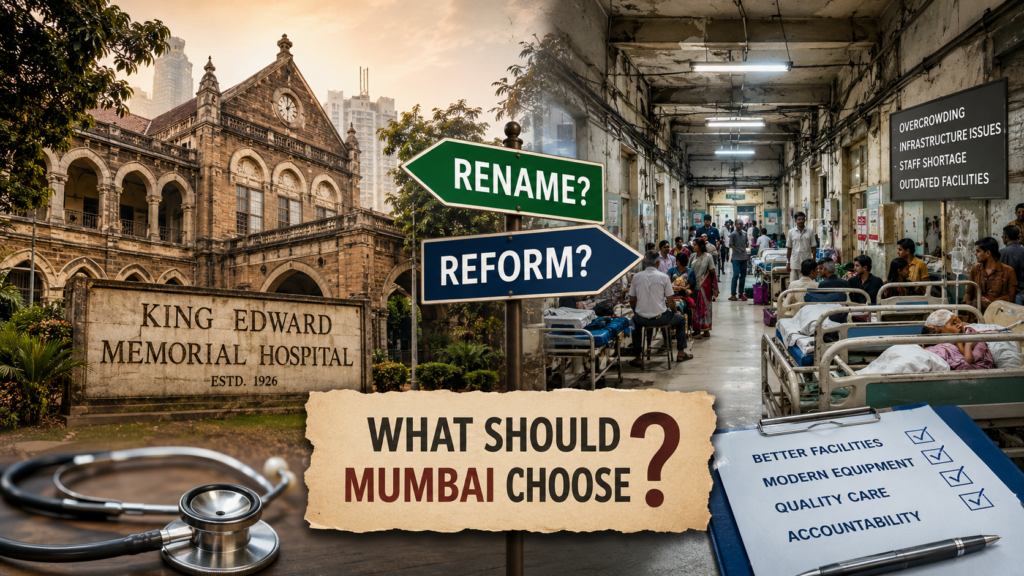
The proposal by the BMC to rename King Edward Memorial Hospital has triggered a strong debate across Mumbai. But this is not merely about changing a hospital’s name. It raises a larger question about history, governance, identity, and public priorities.
KEM Hospital, established during British rule in 1926, was named after King Edward VII. Like many institutions of that era, it carried a colonial identity imposed during British administration. Over the decades, Mumbai and India have renamed several such landmarks:
- Bombay → Mumbai
- Victoria Terminus → CSMT
- Elphinstone Road → Prabhadevi
- And many more……
Those changes were largely justified as efforts to reclaim local history, culture, and post-colonial identity. Therefore, supporters of renaming KEM argue that continuing to retain the name of a British monarch in one of India’s most important public hospitals makes little sense in present-day India.
Yet the opposition to the move is equally strong and emotional.
For generations of Mumbaikars, “KEM” no longer represents colonial rule. It represents affordable healthcare, emergency treatment, medical education, and countless stories of survival. The institution’s identity has evolved beyond the British name attached to it.
More importantly, critics argue that if the administration genuinely wished to create a new legacy, the focus should first have been on transforming the hospital itself.
People naturally ask:
- Should political energy go into changing signboards?
- Or into creating world-class healthcare facilities comparable to All India Institute of Medical Sciences AIIMS, New Delhi?
The condition of Mumbai’s public healthcare system has been debated for years:
- overcrowded wards,
- infrastructure stress,
- shortage of facilities,
- pressure on doctors and staff,
- delayed modernization.
Even within KEM, recurring concerns regarding maintenance, patient load, and infrastructure have remained visible for years. Critics therefore feel that renaming, without visible transformation in healthcare quality, risks appearing more symbolic than substantive.
That is why many see the move less as administrative reform and more as a political exercise. Especially because Mumbai’s municipal administration has often been accused of lethargy regarding larger civic problems roads, flooding, infrastructure, cleanliness, and public healthcare conditions included.
Supporters of the renaming may still argue that correcting colonial symbols is important for cultural self-respect. And historically, Mumbai has indeed accepted many renamed places over time.
But hospitals occupy a different emotional space. People associate them not with politics, but with life, struggle, recovery, and hope.
Perhaps the real debate therefore is not whether KEM should or should not be renamed. The deeper question is this: Would citizens feel prouder of a renamed hospital or of a truly modern, world-class public healthcare institution that sets standards for the country?
Also read: Foundation of KEM Hospital

