


Prabodhankar Keshav Sitaram Thackeray (1885–1973) was much more than the father of Bal Thackeray. He was a journalist, writer, historian, social reformer, public speaker and cultural activist who played an important role in Maharashtra’s social and public life during the first half of the 20th century. Through his writings, the magazine Prabodhan, social campaigns and public activities, he challenged caste discrimination and several prevailing social customs. His long association with Mumbai, particularly Dadar, and his participation in the Samyukta Maharashtra movement also connect his life closely with the history of the city.
In this article
- Early life of Prabodhankar Thackeray
- Why was he called “Prabodhankar”?
- His journalism and Prabodhan
- His contribution to social reform
- Prabodhankar and Dadar
- The beginning of public Navratri celebrations
- His association with Dr. B. R. Ambedkar
- His writings on history and Maharashtra
- His role in the Samyukta Maharashtra movement
- Prabodhankar and the Thackeray family
- A Postage Stamp in his Honour
- His legacy in Mumbai
Early life of Prabodhankar Thackeray
Keshav Sitaram Thackeray was born on 17 September 1885 in Panvel. He grew up in relatively modest circumstances and developed an interest in writing, art, public affairs and social issues at an early age. His thinking was influenced strongly by the ideas of social reformer Mahatma Jyotirao Phule and the Satyashodhak tradition.
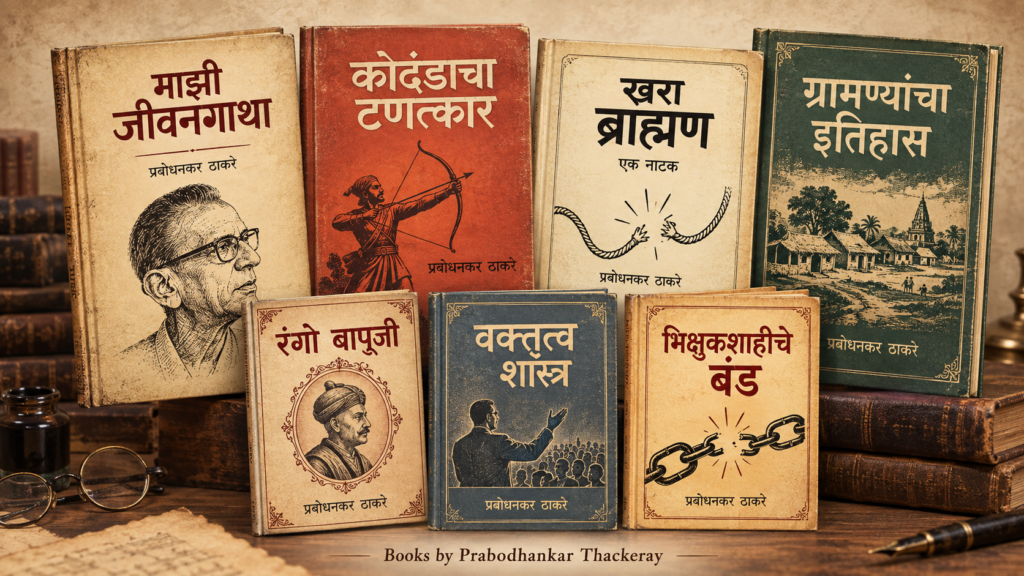
Unlike someone who worked in only one field, Prabodhankar moved across journalism, literature, theatre, history, public speaking and social activism. His own autobiography, Majhi Jeevangatha, provides an account of this unusually varied life.
Why was he called “Prabodhankar”?
The word “Prabodhan” broadly means awakening or enlightenment. Prabodhankar used journalism and public speaking as instruments to awaken people about social inequality and injustice.
He launched the Marathi periodical Prabodhan in 1921. Through it and his other writings, he addressed caste discrimination, social customs, religious practices and questions of social equality.
His writing style was known for being direct and forceful rather than academic. This helped him take social-reform ideas beyond intellectual circles and into wider public debate.
A strong voice for social reform
One of Prabodhankar’s most important contributions was his campaign against social practices that he regarded as unjust.
He spoke against caste discrimination, untouchability, child marriage and dowry and advocated greater equality and social dignity. His reformist activities were influenced by the Satyashodhak movement and the ideas of Jyotirao Phule.
His approach was not limited to writing. He travelled extensively, addressed public gatherings and participated directly in social campaigns.
This makes him an interesting figure in Mumbai’s history: the city was not only a centre of commerce and industry but also an important meeting ground for social reform movements.
Prabodhankar and Dadar
Dadar occupies a special place in Prabodhankar Thackeray’s story.
He was a long-time resident of the Dadar area, and during the 1920s he became involved in public and social activities there. His activities also brought him into contact with prominent social leaders of the period, including Dr. B. R. Ambedkar and Raobahadur S. K. Bole.
This association makes Prabodhankar part of the history of Dadar beyond the political legacy with which the Thackeray name is generally associated today.
The beginning of public Navratri celebrations
One of the most interesting episodes in his Mumbai story concerns Dadar’s public festivals.
In 1926, Prabodhankar was associated with the organisation of the Shri Shivbhawani Navratri Mahotsava through the Lokahitawadi Sangha. The celebrations were intended to bring people together across caste divisions. Historical accounts describe the participation of members of the Dalit community in the celebrations, and Dr. B. R. Ambedkar was also associated with the event.
The event is significant because it shows how public festivals in Mumbai could also become spaces for social reform and questions of equality.
The tradition of public Navratri celebrations associated with this initiative continues to be remembered in Dadar.
His association with Dr. B. R. Ambedkar
Prabodhankar’s activities brought him into contact with Dr. B. R. Ambedkar at a time when questions of caste equality and social reform were becoming increasingly prominent in public life.
Their association is particularly remembered in connection with the Dadar public celebrations of the 1920s. It is an interesting reminder that Mumbai’s social history was shaped by people from different reform movements who sometimes came together around specific social issues.
Writer and historian
Prabodhankar was also a prolific writer and researcher.
He wrote about personalities and events connected with Maharashtra’s history and questioned some established interpretations of the past. His interests extended to the Maratha period, social history and the evolution of Maharashtra’s cultural identity.
His autobiography, Majhi Jeevangatha, remains an important source for understanding his own experiences and worldview. Also many other books which got huge recognition.

His role in the Samyukta Maharashtra movement
Prabodhankar was also associated with the movement for the creation of a Marathi-speaking Maharashtra, including Mumbai.
He participated in public meetings and activities connected with the Samyukta Maharashtra movement. The Indian Express has documented meetings of the movement in Mumbai that were presided over by leaders including Prabodhankar Thackeray.
The movement eventually led to the formation of Maharashtra on 1 May 1960, with Mumbai becoming its capital.
For the detailed history of the movement, read the article: Samyukta Maharashtra Movement.
Prabodhankar and the Thackeray family
Prabodhankar was the father of Bal Thackeray, who later founded the Shiv Sena in 1966.
Because of this family connection, Prabodhankar is often remembered primarily as Bal Thackeray’s father. But that description leaves out much of his own life and work.
His career as a journalist and social reformer began decades before the formation of the Shiv Sena. His contribution therefore needs to be understood independently of the political careers of later generations of the Thackeray family.
A Postage Stamp in his Honour

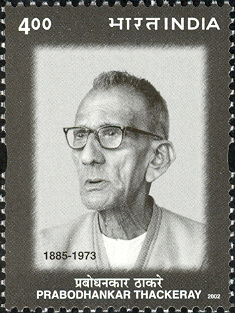
In recognition of his contribution as a social reformer, writer and public figure, India Post issued a commemorative postage stamp dedicated to Prabodhankar Thackeray on 19 May 2002. The ₹4 stamp was released in Mumbai at Shanmukhananda Hall. More than three decades after his death, the stamp remains a lasting national recognition of a man whose writings and social work contributed to the intellectual and social history of Maharashtra.
His legacy in Mumbai
Prabodhankar Thackeray represents an important period in Mumbai’s history when journalism, social reform, public festivals and political movements often overlapped.
His story connects several aspects of the city’s past: the growth of Dadar, Marathi journalism, social reform, caste equality, public cultural celebrations and the movement that eventually created Maharashtra.
| Details | |
|---|---|
| Full name | Keshav Sitaram Thackeray |
| Popular name | Prabodhankar Thackeray |
| Born | 17 September 1885, Panvel |
| Died | 20 November 1973 |
| Known for | Journalism, social reform, writing, history and public speaking |
| Magazine | Prabodhan |
| Mumbai connection | Particularly associated with Dadar |
| Major social concerns | Caste inequality, untouchability, dowry and social reform |
| Family | Father of Bal Thackeray |
| Other contribution | Associated with the Samyukta Maharashtra movement |
Prabodhankar Thackeray’s life story is a story of a person who challenged society, created public movements and changed the way Mumbaikars understood their city. His life provides a link between the social reform movements of early 20th-century Bombay, the evolving identity of Dadar and the larger social and cultural history of Maharashtra.

