


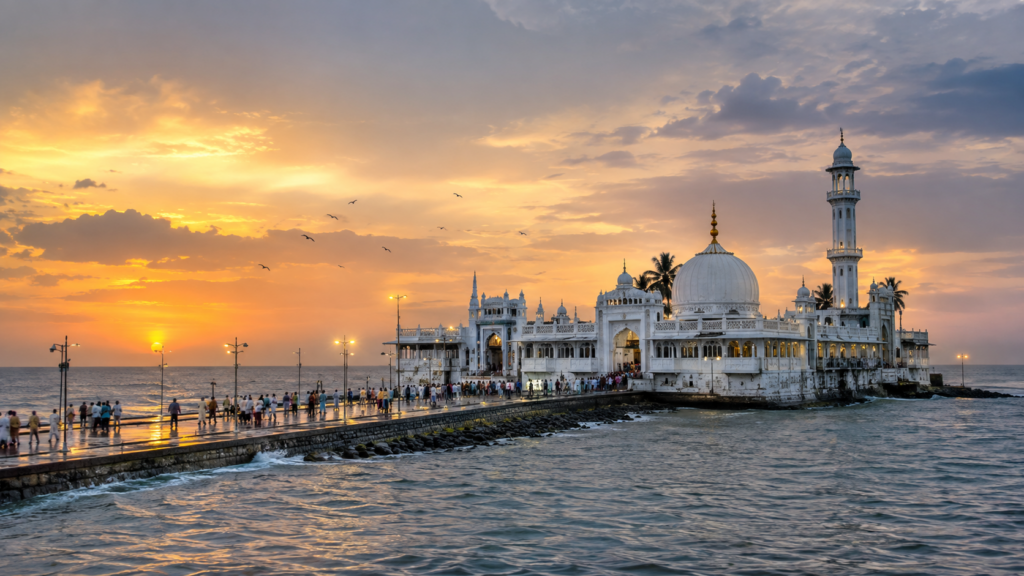
Standing on a small rocky islet in the Arabian Sea, just off the coast of Worli, Haji Ali Dargah is among Mumbai’s most recognisable landmarks. The white-domed shrine, surrounded by the sea and connected to the mainland by a narrow causeway, has become an important part of Mumbai’s cultural and religious landscape. The official Haji Ali Dargah Trust describes the shrine as being visited by people of all religions.
The shrine is dedicated to Pir Haji Ali Shah Bukhari, a Muslim saint and merchant whose tomb is believed to lie within the dargah. The shrine is visited by people from different communities and has long been regarded as a place of prayer, faith and spiritual reflection. The Maharashtra Tourism Department describes it as an Indo-Islamic shrine located on an islet in the Arabian Sea.
The Story of Pir Haji Ali Shah Bukhari
According to the traditional account preserved by the Haji Ali Dargah Trust, Pir Haji Ali Shah Bukhari was a wealthy merchant from Bukhara, in Central Asia. He eventually travelled to India and settled in the region that is now Mumbai.
Tradition associates him with a life devoted to spirituality, charity and helping people. He is believed to have renounced his worldly possessions and devoted himself to religious life.
The stories surrounding his life are part of the oral and devotional traditions associated with the shrine. The Dargah Trust itself cautions that historical information relating to events before the formal establishment of the Trust in 1916 should be understood as traditional material rather than independently verified historical fact.
The Legend Behind Haji Ali Dargah
One of the best-known stories associated with Haji Ali concerns the saint’s final journey.
According to tradition, Haji Ali Shah Bukhari travelled to Mecca and died during the pilgrimage. His followers are said to have followed his wishes regarding his burial, and his body eventually reached the shores of Mumbai.
The shrine is traditionally believed to have been established at the location where his remains were found.
This story is deeply embedded in the devotional history of Haji Ali. However, because it belongs primarily to religious tradition, it is best regarded as a legend associated with the shrine rather than a conclusively documented historical event.
When Was Haji Ali Dargah Built?
The exact early history of the structure is intertwined with tradition. The Municipal Corporation of Greater Mumbai’s tourism material dates the shrine’s construction to 1431, describing it as having been built in memory of Sayyed Peer Haji Ali Shah Bukhari.
The Haji Ali Dargah Trust describes the shrine as more than 500 years old and notes that the present-day complex has undergone substantial reconstruction and restoration over time.
The Trust was formally established as a legal entity in 1916.
Therefore, the Haji Ali Dargah seen by visitors today should not be considered entirely identical to the original medieval structure. It is the result of centuries of religious use, maintenance, reconstruction and restoration.
The Causeway to Haji Ali
The shrine stands approximately 500 yards from the Mumbai shoreline, in the Arabian Sea, and is connected to the mainland by a causeway.
According to the Haji Ali Dargah Trust, the present pathway was constructed between 1944 and 1952, using funds provided by the Trust.
Visitors walk along this narrow approach towards the white structure standing ahead in the sea. The experience combines the atmosphere of a pilgrimage with one of Mumbai’s most unusual coastal walks.
Visitors should, however, be conscious of tide and weather conditions, particularly during the monsoon. The sea can become rough and the pathway may become wet or slippery.
Architecture of Haji Ali Dargah
The white appearance of Haji Ali Dargah gives it a distinctive visual identity against the blue-grey waters of the Arabian Sea.
The complex reflects Indo-Islamic architectural influences, with its prominent dome, minarets, arches and ornamental details. Maharashtra Tourism specifically describes the shrine as being built in the Indo-Islamic architectural style and notes its white-marble appearance.
Inside the main shrine is the tomb of Pir Haji Ali Shah Bukhari. The complex also includes a mosque, minaret, qawwali area and other associated facilities. The official Trust website identifies the principal components of the complex, including the Dargah Sharief, tomb, Qawwal Khana, mosque and minaret.
Reconstruction and Restoration
The structure visible today has undergone considerable reconstruction.
The Haji Ali Dargah Trust states that the present form of the structure was reconstructed between 1960 and 1964. This followed earlier work on the approach pathway and other parts of the complex.
This restoration history is important because it explains why the present shrine should not be viewed simply as an untouched medieval monument. Its significance lies both in its long religious history and in the continued efforts to preserve the site.
Haji Ali and Mumbai’s Changing Skyline & Coastal Road
The surroundings of Haji Ali have changed dramatically over the decades.
What was once a largely open coastal setting is now surrounded by one of the world’s great metropolitan cities. High-rise buildings, busy roads and modern infrastructure dominate the mainland, while the historic shrine continues to stand offshore.
The Mumbai Coastal Road has also reshaped the waterfront, adding new coastal infrastructure and public open spaces. For visitors, Haji Ali is now part of a much more modern and accessible coastal corridor, while the historic dargah continues to stand offshore as a striking contrast to Mumbai’s new infrastructure.
This contrast is one of the reasons Haji Ali remains such a powerful symbol of Mumbai.
How to Reach Haji Ali Dargah
By Western Railway
The nearest major suburban railway station is Mumbai Central on the Western Line. BMC’s visitor information specifically identifies Mumbai Central as the nearest railway station for Haji Ali Dargah.
Another useful option is Mahalaxmi Railway Station, which is also on the Western Line and is located relatively close to the Haji Ali area.
From either station, visitors can continue by BEST bus, taxi, auto-rickshaw where permitted, or other local transport.
By BEST Bus
According to the BMC’s current tourist information, the BEST bus routes serving the area around Haji Ali include:
| BEST Bus Route | Useful connection |
| 80 LTD | Bandra (West) – Walkeshwar |
| 83 | Santacruz Depot – Colaba |
| 351 | Mumbai Central Depot – Tata Power Station |
The BMC specifically lists 351, 80 LTD and 83 among the BEST routes with stops near Haji Ali.
A useful landmark stop is Vatsalabai Desai Chowk (Haji Ali), located in the Haji Ali area. Vatsalabai Desai Chowk (Haji Ali)
Bus routes and stopping patterns can change, so visitors should check the current BEST route information before travelling.
By Road
Haji Ali is situated along Lala Lajpat Rai Marg, making it accessible from Worli, Mahalaxmi, Tardeo, Mumbai Central and South Mumbai.
For visitors coming from the western suburbs, travelling south along the coastal corridor towards Worli and Haji Ali is generally convenient, although journey times can vary considerably with Mumbai traffic.
- The official Trust website provides information about the dargah and its administration. Haji Ali Dargah Trust official website

