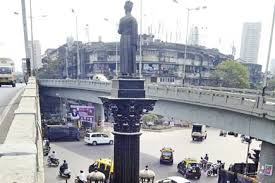
The famous Khada Parsi (Standing Parsi) statue standing tall at the busy Byculla flyover junction was erected as a memorial to Cursetjee Manockjee Shroff (1808–1877). He was often respectfully referred to as Shet Cursetjee Manockjee, was a prominent Parsi merchant, industrial pioneer, and philanthropist of 19th-century Bombay (now Mumbai). He played a major role in shaping the commercial and social life of the city during the British colonial period.
He developed his career in trade, ship-related commerce, and finance, gradually building considerable wealth and influence.
His philanthropic work included donations to educational institutions, contributions to community welfare, support for Parsi religious and charitable trusts and assistance for public causes in Bombay
His reputation for generosity and leadership earned him the respectful title “Shet”.
Background of the memorial
Cursetjee Manockjee died in 1845. He was remembered for his charitable activities and for supporting education in Bombay, particularly the early movement for girls’ education. He had helped establish what later became the Alexandra Girls’ English Institution, one of the earliest schools for girls in the city.
To honour his memory, his son Manockjee Cursetjee decided to erect a public monument.
Making of Khada Parsi
The statue was commissioned by his son Manockjee Cursetjee. He was a well-known judge, reformer, and supporter of women’s education in Bombay. He ordered the monument to commemorate his father’s public service and philanthropy.
Year and construction
The monument was erected around 1865–1869 in Bombay. It reportedly cost about ₹20,000, a very large amount at that time. The structure was manufactured in London, shipped to Bombay in parts, and assembled here.
Structure of the monument
The Khada Parsi monument is about 40 feet tall cast-iron structure. A bronze statue of Cursetjee Manockjee stands on top of a tall Corinthian column. The base includes ornamental sculptures and originally had gas lamps that illuminated the monument at night.
Why it became known as “Khada Parsi”
The statue depicts Cursetjee Manockjee standing upright in traditional Parsi attire. Because of this posture, locals began referring to it simply as “Khada Parsi” (the Standing Parsi), and eventually the name became associated with the entire junction in Byculla.
The statue was restored in 2012, but as the city developed, it got hidden between the flyover roads.
But still today, the Khada Parsi statue remains one of Mumbai’s oldest surviving public memorials, standing for more than 150 years as a reminder of the city’s Parsi heritage.