


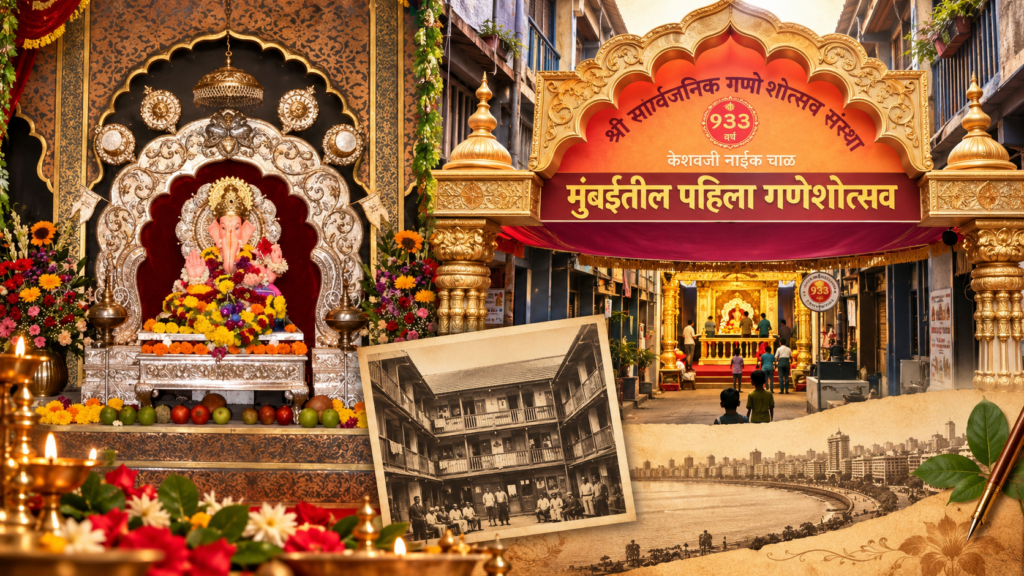
The story of the extraordinary festival in the city began with a small Ganesh idol in a historic chawl in Girgaon.
Keshavji Naik Chawl Ganpati, established in 1893, is widely regarded as Mumbai’s oldest surviving Sarvajanik Ganeshotsav tradition. More than 130 years later, The Keshavji Naik Chawl Ganpati is significant not only because it is one of Mumbai’s oldest public Ganeshotsav celebrations, but also because it has preserved the original spirit of the festival.
The chawl’s history and its Ganeshotsav tradition are documented in the heritage records of the Municipal Corporation of Greater Mumbai.
The small Shadu clay idol, the traditional sculpting family, the community courtyard and the peaceful celebration together represent a form of Ganeshotsav that is deeply connected to Mumbai’s history.
At a time when environmental responsibility is becoming increasingly important, this historic mandal reminds us that devotion and sustainability can go hand in hand.
The Beginning of Mumbai’s Public Ganeshotsav
In the late nineteenth century, Ganesh Chaturthi was primarily celebrated within individual homes. The idea of bringing Lord Ganesha into a common public space was closely associated with Lokmanya Bal Gangadhar Tilak, who promoted public Ganeshotsav as a means of bringing people together and strengthening social unity.
In 1893, residents of Keshavji Naik Chawl responded to this idea and began their own public Ganeshotsav. The festival was initiated by a group of residents, including Raobahadur Limaye, Baburao Dhakas, Naraharashastri Godse, Appasaheb Gokhale and Madhavrao Nandivdekar.
The first idol was installed in Naraharashastri Godse’s ground-floor residence. As more residents wished to participate, the celebration was moved to the common courtyard between the chawl buildings. This simple change transformed a household religious observance into a celebration shared by the entire community.
A Historic Visit by Lokmanya Tilak
One of the most important events in the mandal’s history was the visit of Lokmanya Tilak in 1901.
According to the mandal’s historical records, Tilak visited the chawl on 16 September 1901 and addressed the gathering. His visit became an important part of the festival’s legacy and symbolised the connection between public Ganeshotsav and the social awakening of the period.
The mandal has continued to preserve this history through its celebrations and historical activities.
The Traditional Ganesh Idol
The Keshavji Naik Chawl Ganpati is known for its modest size and traditional appearance. Unlike many modern public Ganesh idols, which are often several metres high, the idol at this historic mandal is approximately 2 to 2.5 feet tall.
The idol is made of Shadu clay, and its traditional form has been maintained over the years. The intention is to preserve the character of the original celebration rather than compete through size or grandeur.
The “More” Family’s Sculpting Tradition
The responsibility of making the idol has remained associated with the More family for generations.
The family’s sculpting tradition dates back to the early days of public Ganeshotsav. According to historical reporting, the fifth generation of the family has continued making Ganesh idols for Keshavji Naik Chawl.
This continuity is especially significant because the idol’s traditional form and material have remained largely unchanged. The sculptor’s work is not merely the creation of a religious object; it is also the preservation of a historic artistic tradition.
An Eco-Friendly Ganeshotsav
The Keshavji Naik Chawl Ganpati is an excellent example of how environmental responsibility can be incorporated into a traditional religious celebration.
The use of Shadu clay is an important feature of the idol. Natural clay is more suitable for environmentally responsible immersion than plaster of Paris, particularly when combined with appropriate natural colours and materials.
The mandal is also known for its simple celebration, without the emphasis on elaborate spectacle that characterises many large Ganeshotsav events. Historical accounts have noted the absence of loudspeakers and the focus on a peaceful, community-led festival.
Website: https://1stganeshfestival.com/
Address and How to Reach
Mandal: Shri Sarvajanik Ganeshotsav Sanstha, Keshavji Naik Chawl Ganpati
Address: Keshavji Naik Chawl, Girgaon, Mumbai, Maharashtra – 400004.
The idol is traditionally installed in the common courtyard of the chawl. It is important to remember that this is a historic residential area, not a large open-ground pandal.
By Local Train
Charni Road Station is a practical railway approach for visitors coming from the Western Line.
From Charni Road, devotees can continue towards Girgaon and reach the chawl area on foot.
Read about other Eco Friendly Sarvajanik Ganesh Mandals of Mumbai

