


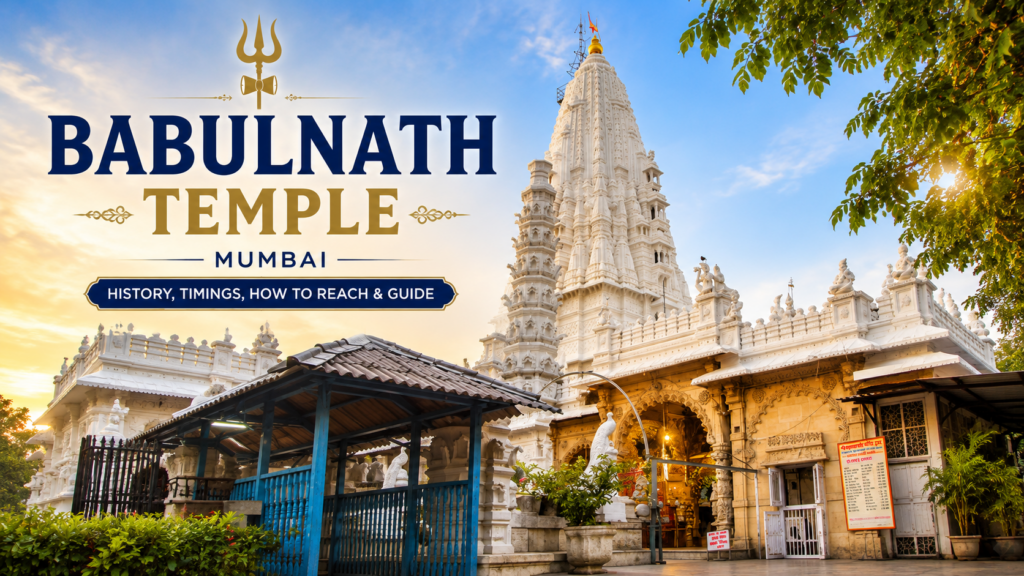
Babulnath Temple is one of Mumbai’s oldest and most revered Shiva temples. Dedicated to Lord Shiva, this sacred shrine stands as a spiritual landmark in South Mumbai and attracts thousands of devotees, especially on Mondays, during Shravan, and on Maha Shivratri.
Unlike many modern temples in Mumbai, Babulnath carries a unique old-world charm. The temple sits atop a hillock, offering not just divine serenity but also a beautiful view of the surrounding city. For devotees, the climb to Babulnath is symbolic ascending towards Lord Shiva, whose heavenly abode is believed to be Mount Kailash.
History of Babulnath Temple
Babulnath Temple is believed to have origins dating back to the 12th century, making it one of Mumbai’s oldest temples dedicated to Lord Shiva. Historical records suggest that the temple and the sacred Shivling existed during the rule of the Solanki dynasty in western India.
Over time, the original temple structure disappeared, likely due to invasions and changing settlements. The sacred site remained hidden until it was rediscovered centuries later.
The present structure was rebuilt in the late 18th century and further expanded in the 19th century. By 1890, Babulnath had become one of the most prominent temple structures in Bombay.
Even today, Babulnath remains a powerful symbol of Mumbai’s spiritual heritage amidst the city’s fast-paced urban life.
The Legend Behind Babulnath Temple
The most popular legend associated with Babulnath revolves around a cow and a cowherd named Babul.
Long ago, the hill where the temple stands belonged to a wealthy goldsmith named Pandurang. His cows grazed peacefully on this land under the care of a cowherd called Babul.
One day, Pandurang noticed that one healthy cow was mysteriously producing less milk. Curious, he asked Babul to observe carefully.
Babul soon discovered something astonishing. Every evening, the cow would go to one particular spot and release milk directly onto the ground.
When Pandurang learned this, excavation began at that location. During the digging, a sacred Swayambhu Shivling (self-manifested Shivling) was discovered along with idols of Ganesh, Hanuman, and Parvati.
This divine discovery led to the construction of the temple, and it came to be known as Babulnath—named after the cowherd Babul.
Religious Importance of Babulnath Temple
Babulnath Temple holds immense significance for Shiva devotees.
Lord Shiva here is worshipped in the form of Babulnath, often interpreted as the “Lord of the Babul Tree.” Mondays are especially auspicious as they are dedicated to Lord Shiva. During Shravan month, the temple witnesses huge crowds from across Mumbai.
Maha Shivratri is the biggest celebration here, with devotees queuing for hours for darshan and special pujas.
Architecture of Babulnath Temple
Babulnath Temple beautifully blends spirituality with traditional temple architecture.
The temple structure features:
- Intricate marble carvings
- Decorative pillars
- Beautifully sculpted ceilings
- Traditional Hindu temple design
- Spacious prayer halls
The temple sits atop a hill, and devotees traditionally climb around 110 steps to reach the main shrine. For elderly visitors and those unable to climb, a lift facility is also available.
Inside the sanctum lies the sacred Shivling, which remains the spiritual centre of the temple.
The atmosphere inside is calm, devotional, and deeply meditative.
Main Deities in the Temple Complex
Though Lord Shiva is the principal deity, the temple complex also houses shrines dedicated to other Hindu deities.
You will find shrines of Lord Ganesha, Goddess Parvati, Lord Hanuman, Lakshmi Narayan, Gayatri Mata, Datta Mandir. This makes Babulnath not just a Shiva temple but a spiritually rich religious complex.
Festivals Celebrated at Babulnath Temple
Maha Shivratri – This is the most important festival at Babulnath. Thousands of devotees visit for night-long prayers, special abhisheks, and darshan.
Shravan Month – Every Monday in Shravan sees a large number of devotees offering milk, bel leaves, and flowers to Lord Shiva.
Kartik Purnima – Special prayers and rituals are held.
Mondays – Weekly Mondays are considered highly sacred and attract regular devotees.
Babulnath Temple Timings
Darshan Timings
- Monday: 6:00 AM – 10:00 PM
- Tuesday to Sunday: 6:00 AM – 9:00 PM
Aarti Timings
- Morning Aarti: 5:30 AM – 6:30 AM
- Noon Aarti: 11:30 AM – 12:30 PM
- Evening Aarti: 5:30 PM – 6:30 PM
- Night Aarti: 7:45 PM – 8:15 PM
Timings may vary during festivals and Shravan month.
How to Reach Babulnath Temple
By Train
Nearest railway stations:
- Charni Road Railway Station
- Grant Road Railway Station
Charni Road is the most convenient station. The temple is a short walk or taxi ride from there.
By Road
The temple is easily accessible by taxi, private vehicle, or BEST buses from South Mumbai.
Watch video of Babulnath Temple


