


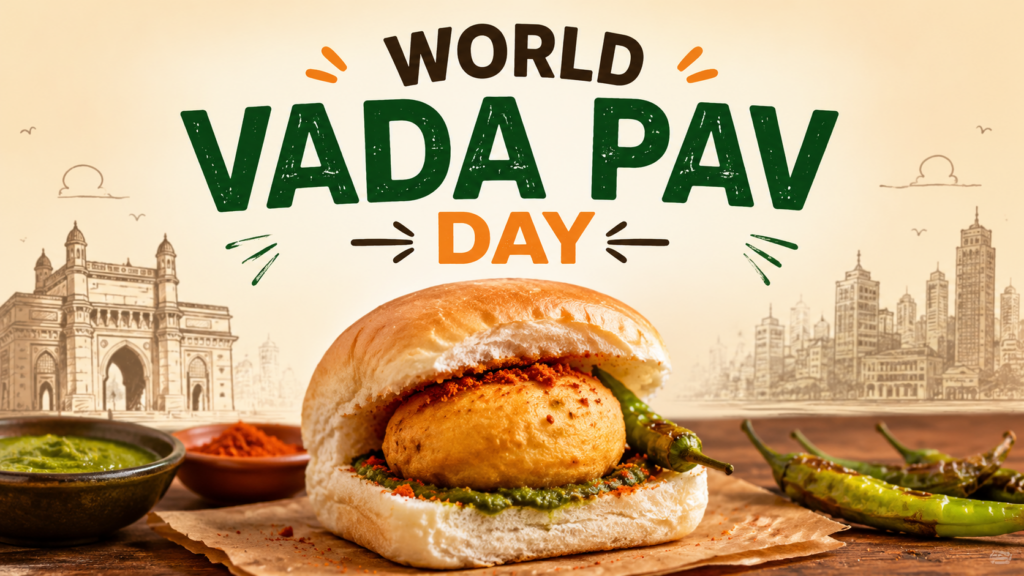
Every Mumbaikar knows the feeling: a hot vada, a soft pav, spicy chutney and a fried green chilli. Simple, filling and affordable, vada pav is much more than a snack in Mumbai. It is part of the city’s everyday life and street-food culture.
Every year, 23 August is observed as World Vada Pav Day, celebrating one of Mumbai’s most popular food creations. The day is an opportunity to remember the humble beginnings of vada pav and how this simple street snack travelled from the streets of Mumbai to cities across India and even other parts of the world.
What Exactly Is Vada Pav?
Vada pav is made by placing a hot batata vada inside a sliced pav, usually with chutneys and a fried green chilli.
The vada is prepared from mashed potatoes mixed with spices, green chilli, mustard seeds, garlic and other ingredients. It is shaped into a ball, covered with gram-flour batter and deep-fried until crisp and golden.
The fried vada is then placed inside a soft pav. Garlic chutney, green chutney or other spicy chutneys are added according to taste.
It is simple, quick to eat and reasonably inexpensive. These qualities helped make it perfect for Mumbai’s fast-moving lifestyle.
Where Did Vada Pav Begin?
The most widely accepted story places the birth of modern vada pav in Dadar, Mumbai, in the mid-1960s.
Ashok Vaidya, a food vendor near Dadar railway station, is widely credited with creating the combination of batata vada and pav around 1966. Some accounts also mention Sudhakar Mhatre, who was selling a similar combination around the same period.
Because of these different accounts, it is better to say that Ashok Vaidya is widely credited with creating or popularising vada pav rather than treating the story as completely undisputed.
The idea was wonderfully simple: take a hot potato vada and put it inside a pav. What emerged was an inexpensive meal that could be eaten quickly, even while travelling.
Why Did Vada Pav Become So Popular?
The answer is closely connected with the history of Mumbai.
During the 1960s and 1970s, the areas around Parel, Worli, Dadar and central Mumbai were closely associated with textile mills. Thousands of workers travelled through these areas every day.
Mill workers and other commuters needed food that was quick to eat, filling, easy to carry, affordable and it was available easily.
So, Vada pav fitted perfectly into this need. Vada pav could simply be wrapped, picked up and eaten within minutes. This made it especially suitable for Mumbai’s busy workers, students and commuters.
During the 1970s and 1980s, its popularity increased rapidly. Small food stalls became an important source of livelihood for many people, and vada pav was ideal for such businesses because it required simple ingredients and could be prepared quickly.
Soon, railway stations, markets, colleges, office areas and busy streets had their own vada pav stalls.
Why Is 23 August Celebrated as World Vada Pav Day?
23 August is popularly celebrated as World Vada Pav Day, but it was not officially declared by the Government of India or any international organisation.
The observance appears to have been started as a promotional initiative by Jumboking, the Mumbai-based vada pav chain. In 2013, The Times of India identified Jumboking founder Dheeraj Gupta as the person who initiated Vada Pav Day. The celebration was already being reported by newspapers in 2007.
There is also a popular story that 23 August was the day Ashok Vaidya first put batata vada inside pav at Dadar. However, this claim is not firmly established by historical records.
Vada Pav and the Spirit of Mumbai
Vada pav is more than a popular snack—it is a part of Mumbai’s identity. Simple, affordable and quick, it is enjoyed by people from all walks of life. While modern varieties like cheese and Schezwan vada pav are now popular across India, the classic combination of hot batata vada, soft pav, spicy chutney and green chilli remains a favourite. Today, vada pav is also served in high-end hotels and restaurants, showing how this humble street food has grown into a much-loved culinary icon. On 23 August, World Vada Pav Day celebrates not just this iconic snack, but also Mumbai’s street-food culture, hardworking people and small food vendors.
Famous Vada Pav Places in Mumbai & Thane
Mumbai and Thane have hundreds of vada pav stalls, but a few have become particularly popular for their distinctive taste, history or variety. Here are some places worth trying.
Famous Vada Pav Places in Mumbai & Thane:
| Place | Area & Address | What Makes It Special |
|---|---|---|
| Ashok Vada Pav (Kirti College Vada Pav) | Kashinath Dhuru Marg, Dadar West, Mumbai 400028 | One of Mumbai’s most iconic vada pav stalls. Known for its crispy vada, spicy chutneys and traditional taste. |
| Aram Vada Pav | Capital Cinema Building, 126 Dr. Dadabhai Naoroji Road, Fort, Mumbai 400001 | A South Mumbai institution with a history of more than 70 years. Famous for its garlic chutney, and also offers grilled cheese and mirchi vada pav. |
| Anand Vada Pav | Gulmohar Road No. 1, opposite Mithibai College, Vile Parle West, Mumbai 400056 | Popular with students and food lovers. Known for large vadas and varieties such as butter, cheese, Schezwan, grill and mayonnaise vada pav. |
| Graduate Vada Pav | Byculla Station Road, Byculla East, Mumbai 400008 | A long-running family stall known for its crispy vadas and several chutney choices, including chilli, garlic, tamarind and coconut. |
| Samrat Vada Pav | Nehru Road, Parleshwar, Vile Parle East, Mumbai 400057 | Has a distinctive coconut addition to the potato filling, giving its vada pav a different flavour from the usual version. |
| Babu Vada Pav | Hanuman Road, Navpada, Vile Parle East, Mumbai 400057 | A popular local option known for its traditional-style vada pav and strong following in Vile Parle. |
| Bhau Vada Pav | Shop No. 1, Patil Bhavan, Netaji Subhash Chandra Road, Mulund West, Mumbai 400080 | A popular suburban choice, particularly for those looking for a traditional, quick street-food style vada pav. |
| Famous Masala Vadapav – Mulund | Purushottam Kheraj Road, Dr Ambedkar Road, opposite Kalidas Auditorium Road, Mulund, Mumbai 400080 | Worth trying if you want a masala-oriented version with a stronger, spicier flavour profile. |
Famous Vada Pav Places in Thane
| Place | Area & Address | What Makes It Special |
|---|---|---|
| Gajanan Vada Pav | Chhatrapati Sambhaji Road, Naupada, Thane West 400602 | Established in 1978 and one of Thane’s best-known names. Famous for its besan chutney and spicy chilli thecha. |
| Rajmata Vada Pav Centre | Sridhar Building, Ram Maruti Road, opposite Bank of Baroda, Ghantali, Thane West 400602 | Known for its soft vada pav and high daily demand. A good choice for those who prefer a softer, less aggressively crisp style. |
| Kunj Vihar Restaurant & Sweets | Prabhavati Bhawan, Station Road, opposite Ashok Talkies, Jambli Naka, Thane West 400601 | A long-running Thane food outlet dating back to 1958, making it an interesting stop for those looking for an old Thane food institution. |
| Aapte Joshi Vada Pav | K.Joshi English School area, Priyadarshini Society, Shop No. 3, Ghantali Devi Road, Naupada, Thane West 400602 | A popular local option in Naupada and worth including on a Thane vada pav trail. |
Which Ones Are Best for a Vada Pav Trail?
For someone wanting to experience different styles rather than simply visiting the most famous names, a good shortlist would be:
- Traditional Mumbai style: Ashok Vada Pav, Dadar
- Garlic chutney: Aram Vada Pav, Fort
- Cheese/Schezwan & modern varieties: Anand Vada Pav, Vile Parle
- Different chutneys: Graduate Vada Pav, Byculla
- Coconut-flavoured twist: Samrat Vada Pav, Vile Parle
- Besan chutney & thecha: Gajanan Vada Pav, Thane
- Soft-textured vada pav: Rajmata Vada Pav, Thane
- Old Thane institution: Kunj Vihar, Thane
Tip: Taste preferences are highly personal, so these should be treated as well-known and distinctive places rather than a definitive ranking of the “best” vada pav in Mumbai or Thane.
Documentaries on Vada Pav
Here are well documented video on Vada Pav


